
| Back to search results » | Back to search page » |


|
Harper's Lane Bridge over Melbourne - Bendigo Railway
Other NamesVicRoads Structure ID. VC054 , National Trust Bridges Database Reg. No. 750 LocationHarpers Lane, off Lauriston Reservoir Road,, KYNETON VIC 3444 - Property No B7319
File NumberB7319LevelState |
|




Statement of Significance
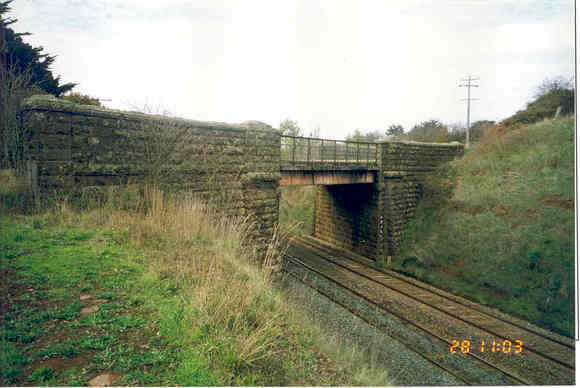
What is significant? The Harpers Lane Bridge is a bluestone and wrought iron road over rail bridge situated on the Melbourne Bendigo Railway at Kyneton. It was built in 1862-4 and is one of a group of similar bridges on this line.
How is it significant? The Harpers Lane Bridge is significant for aesthetic/architectural, historic, and scientific (technical) reasons at a State level.
Why is it significant? The Harpers Lane bridge is of historical and technical significance as one of the oldest extant metal plate girder road bridges in Victoria in original form. The association of the bridge with the Melbourne Mount Alexander and Murray River Railway is significant, not only because of the large scale of public works associated with the construction of this line and its importance to the economic development of the colony, but also because of the key role that this project played in introducing the use of riveted wrought-iron plate girders to Victoria for both railway and road bridge construction. Prior to 1870 there were very few metal road bridges of any type built in Victoria and of the surviving examples attributed to this period which appear to retain their original riveted wrought-iron plate girders, all were associated with the construction of either the Melbourne-Bendigo, Ballarat-Geelong,or Melbourne-Brighton Railways.
The Harpers Lane Bridge, being the earliest of the form, may well be the prototype for other bridges along the line further north, which although varying in detail, follow a very similar pattern. The development of composite masonry and wrought iron bridge construction as demonstrated in this bridge may also reflect the crisis of the stone mason's strikes of 1858-61 and a subsequent change in bridge design which this event may have caused.
The Harpers Lane Bridge is similar to several other metal road bridges over the same line.
These are significant as a group, which represents an outstanding historical event and engineering achievement. The very intact condition and early date of the Harpers Lane Bridge provide the potential to yield important information about the introduction of this style of bridge on the Melbourne Mount Alexander and Murray River Railway and the to the whole of Victoria more generally.
It demonstrates the high engineering standards and fine workmanship which are characteristic of the Bendigo Railway and provides a marker for the importation and adaptation of British engineering and technology, based on the wealth of the gold rushes and increasing political and financial power of the new Victorian Colonial Government. The combination of masonry abutments and metal girders in the design of the bridge is characteristic of the Bendigo Line which was engineered to British main-line standards under the influence of Andrew Clarke and given the stamp of approval by the British Inspecting Engineer Isambard Kingdom Brunel, one of history's most famous and most influential engineers. The bridge and the rail route are of historical significance as part of the first main country trunk route linking the goldfields with the ports of Geelong and Melbourne (the other line being the contemporary Geelong-Ballarat line). The provision of access across this line was subject to political debate and often resulted in bridges of a very high engineering standard serving little used roads and private access. The case of Harper's Lane, the bridge did serve an important local route, giving access to an early crossing place of the Campaspe river at the foot of Mill Street. With the new station reorienting the town settlement, the Kyneton-Trentham Road became the more important crossing.
The Harpers Lane Bridge is of aesthetic significance for the finely detailed and balanced execution of the design, which successfully blends the disparate materials of wrought iron and bluestone on a difficult sharp skew angle. The design solves the challenging problems for early bridge engineers and designers of incorporating metal girders and results in a unique design solution which uses string courses to define structural components such as the foundation plinths and girder sills, and balances the relatively slender girder with parapet walls of a similar scale. The curved and tapered brackets of the handrails offer a delicate detail to balance the solidity of the rest of the structure. The string courses also carry the horizontal lines of the girders and handrails through the length of the structure, abutments and wing walls. In its original form the corrugated galvanised iron balustrade panels would have created a more solid profile to the structure.
Classified: 30/04/2005
Group
Transport - Road
Category
Road Bridge