
| Back to search results » | Back to search page » |


|
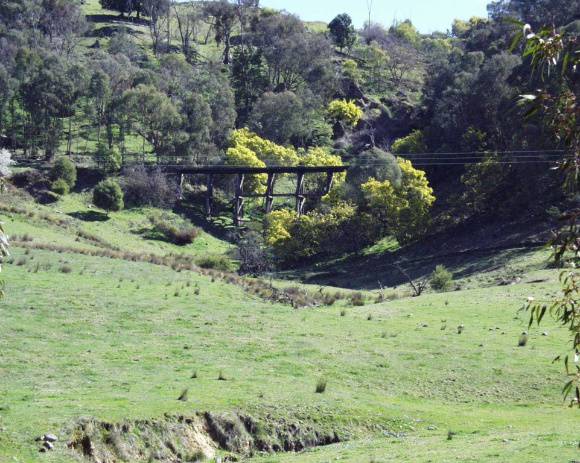
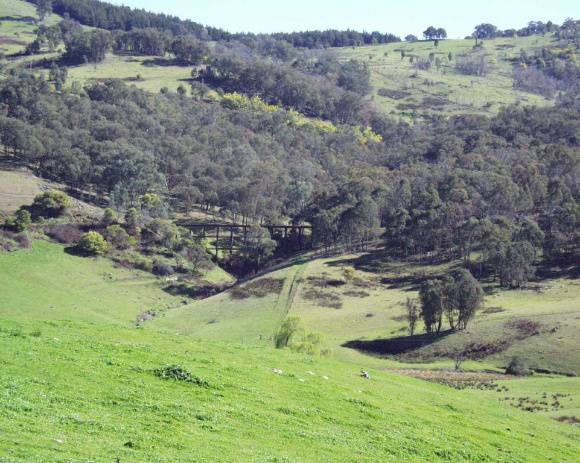
Darbyshire Hill No.1 & No. 2 Bridges
LocationWodonga-Cudgewa Railway, midway between Bullioh & Darbyshire,, BULLIOH VIC 3700 - Property No B6949
File NumberB6949LevelState |
|




Statement of Significance
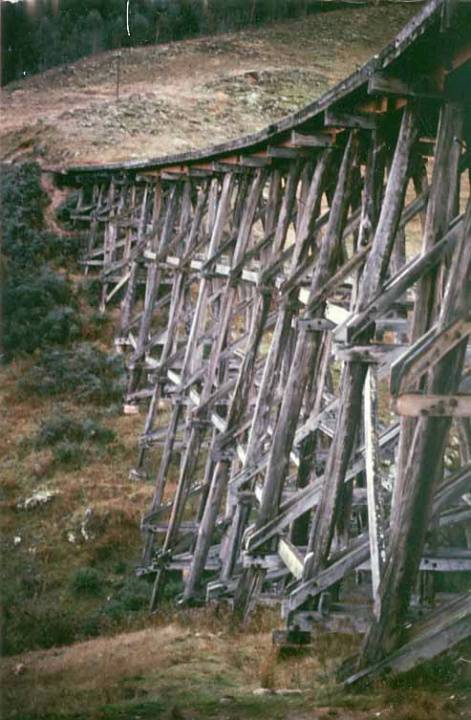
What is significant? Darbyshire Hill Nos. 1 and 2 Bridges are single-track rail bridges of three-storey pier design and combine standard fifteen feet timber-beam approach spans with twenty feet rolled-steel-joist spans over the main channels. The timber piers on these bridges are fitted with rare double-longitudinal walings.
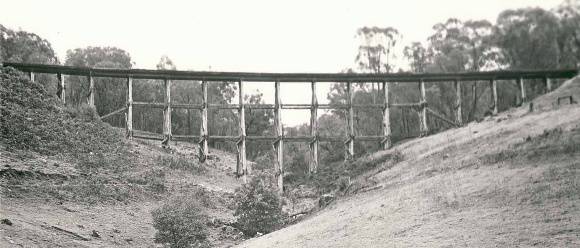
No. 2: timber and steel composite rail bridge 96.6 metres (317 feet) long, with unusually tall 4 pile timber piers (max. height, 21.3 metres, 79 feet), six timber-beam approach spans each of fifteen feet (4.6 metres), eleven rolled-steel-joist spans each of twenty feet (6.1 metres), and a straight deck of standard transverse-timber design. This bridge, 21.3 metres high, is the tallest railway bridge of timber and steel joist construction to survive in Victoria.
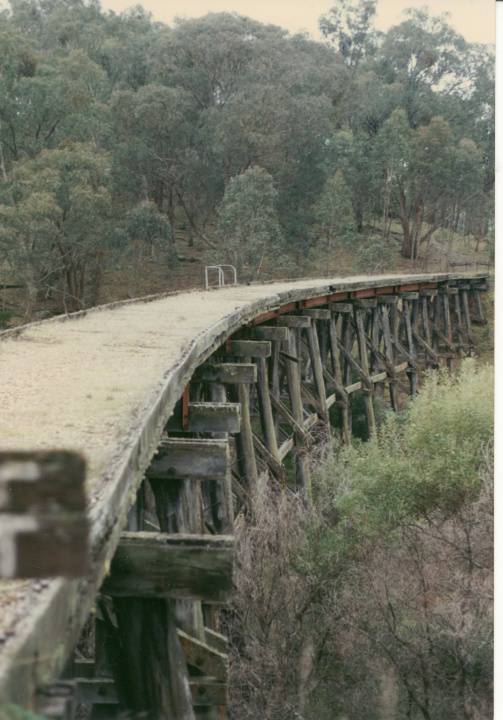
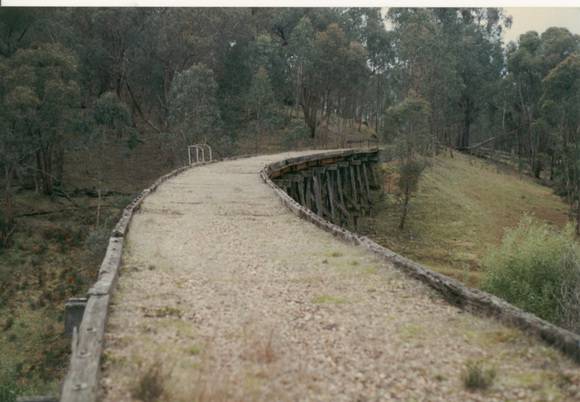
No. 1 timber and steel composite rail bridge 65.48 metres (215 feet) long, with unusually tall 4 pile timber piers (max. height, 16.45 metres, 54 feet), and a curving transverse-timber deck. This bridge has five timber-beam spans each of standard fifteen feet (4.6 metre) Victorian Railways design, and seven rolled-steel-joist spans each of twenty feet (6.1 metres).
Darbyshire Hill Nos.1 and 2 Bridges were built in 1916 as part of the Wodonga-Cudgewa railway. The line was closed in 1981.
How is it significant? Darbyshire Hill Nos. 1 and 2 Bridges are significant for technical, historic and aesthetic reasons at State level.
Why is it significant? Darbyshire Hill Nos.1 and 2 Bridges are of technical significance as a major engineering feature of the steepest and most twisty section of line on the Victorian Railways system. They were first built in 1916 as all-timber-beam bridges on very tall four-pile timber piers, on a line mainly intended to carry mountain cattle towards metropolitan markets. After World War 2 this railway was the main supply line for the massive infrastructure works of the Snowy Mountains Hydro-electric Scheme. The original timber superstructure design was then modified by substitution of steel-joists for timber beams on twenty feet (6.1 metres) spans, to meet increased load demands. This timber-steel joist composition is very unusual.
Darbyshire Hill Nos.1 and 2 Bridges are of historic significance as part of the Wodonga-Cudgewa line, which was the main supply rail line during the construction of the Snowy Mountains Hydro-electric Scheme. These are the tallest bridges surviving on this line.
Darbyshire Hill No. 2 Bridge is of historic significance as the tallest railway bridge (70 feet, 21.3 metres) of composite timber and steel construction to survive in Victoria.
Darbyshire Hill Nos.1 and 2 Bridges are aesthetically significant because of the unusual height of their three-storey timber trestles, and provide a striking spectacle, visible from the Murray Valley Highway against the backdrop of the Koetong Hills. The bridges are on the developing (as of 2011) High Country Rail Trail.
Classified: 10/11/1998
Group
Transport - Rail
Category
Railway Bridge/ Viaduct