
| Back to search results » | Back to search page » |


|
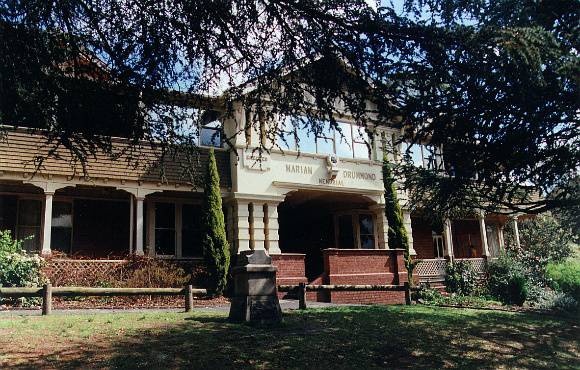
MARIAN DRUMMOND NURSES' HOME FORMER
LocationStudley Road HEIDELBERG, Banyule City LevelIncluded in Heritage Overlay |
|




Statement of Significance
Building: Architecturally, the Marian Drummond Building is an interesting example of a late Federation transitional bungalow style applied to an institutional building. The half-timbering to the central gable is a Queen Anne element, while the pitch of the gable itself is more typical of the Federation bungalow styles. The combination of geometric pattern iron balustrading panels at the lower level and shingled weatherboards to the upper level is also unusual.
The building is also of some historical significance. With the exception of the former Bowen Nurses' Home, which is now very substantially altered, the Marian Drummond Memorial Nurses' Home appears possibly to be the earliest surviving purpose-built nurses' home in metropolitan Melbourne. The Nurses' Home at the Alfred Hospital, constructed in 1908, was recently demolished. Other nurses' homes were constructed in the post-World War Two period, and many of these have also been demolished. The Queen Victoria Hospital Nurses' Home, formerly the Melbourne Hospital, was demolished in 1994; the Royal Melbourne Hospital Nurses' Home (c.1950s) has been converted to offices, as have the St Vincent's Hospital's Nurses' Home (1958) and the Children's Hospital Nurses' Home (c.1950); Prince Henry's Hospital Nurses' Home has been demolished along with the rest of the hospital complex, and the Western Hospital Nurses' Home (c.1950) was demolished in 1987. The Nurses' Home at the former Methodist Babies' Home, Copelen Street (constructed in the 1930s) was extant in 1993, however, it would appear that the of the surviving nurses' homes in the metropolitan area, the closest in date to the Marian Drummond is the Edward Wilson Nurses' Home (1925), also at the Austin. Further research would be required to clarify this issue.
The building is of a level of significance which would warrant retention and conservation of the external fabric. Historically and architecturally the building is at least of local significance and potentially of state significance. Its retention is considered to be essential.
[Extract: Allom Lovell & Associates. Austin Campus: Austin and Repatriation Medical Centre, Melbourne, 1997]. LANDSCAPE: The Austin Hospital is enhanced by its landscape setting, which includes a wide variety of mature trees. The trees contribute significantly to the character of the area, and the aesthetic appeal of the hospital grounds.
Group
Health Services
Category
Nurses' Home