
| Back to search results » | Back to search page » |


|
UNDERGROUND PUBLIC TOILETS
LocationELIZABETH AND VICTORIA STREETS MELBOURNE, MELBOURNE CITY
File NumberPL-HE/03/0766LevelRegistered |
|




Statement of Significance
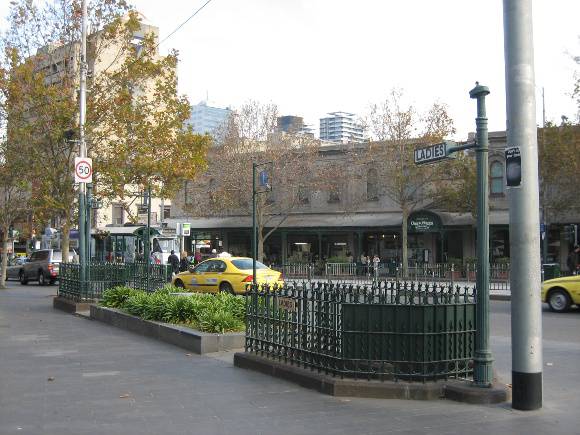
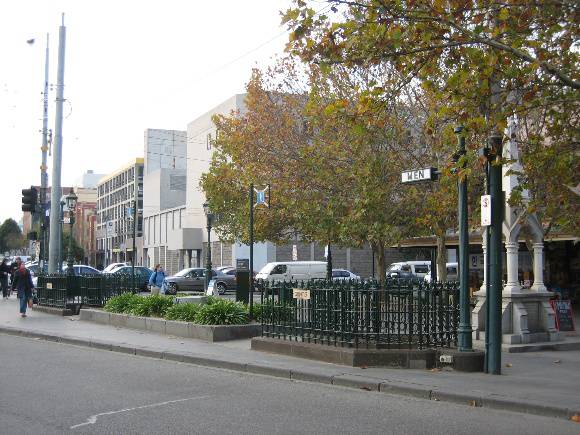
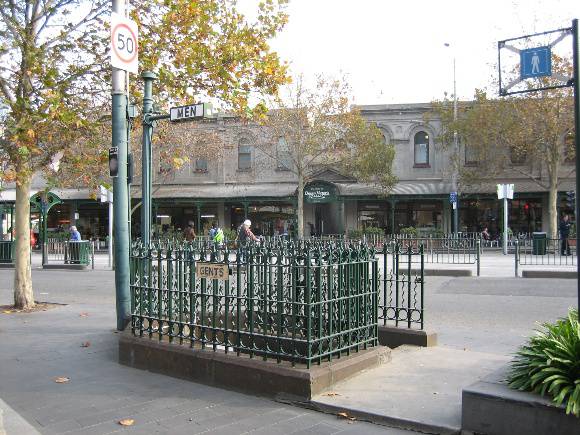
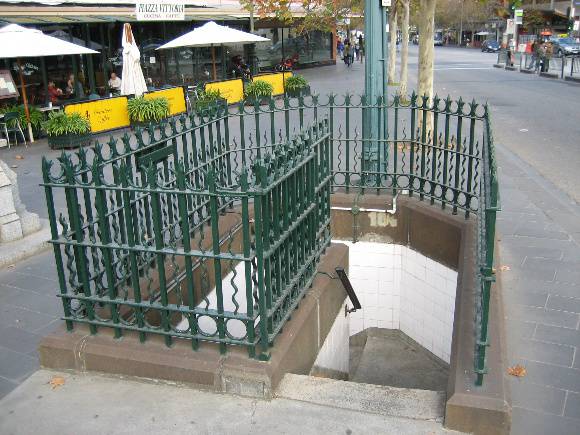
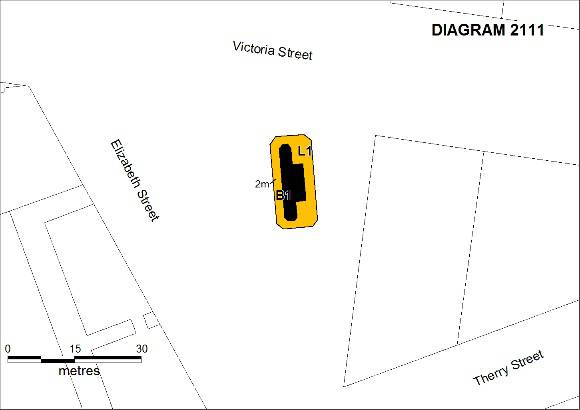
What is significant? The underground public toilet near the corner of Elizabeth and Victoria Streets, built in 1907, is one of a group of such facilities built in Melbourne in the early twentieth century in response to increasing demand for public toilet facilities in the city that were both sanitary and discreet. Until 1902 there were no public toilets for women and few for men. The first public toilet, a urinal for men only, had been built in 1859, following the opening of the Yan Yean water supply in 1858. But these street level toilets were regarded as indecently public, and without an underground sewerage system the waste discharged into the gutters. Underground toilets, which removed toilets from public view and so satisfied contemporary perceptions of decency, had already been built in Scotland, England and Sydney. Such facilities were made possible in Melbourne by the establishment in December 1890 of the Melbourne & Metropolitan Board of Works, responsible for building and maintaining an underground sewerage system. The first underground public toilet in Melbourne, which was the first public toilet for women in the city, was opened in Russell Street in 1902, followed by another one for men in Queen Street in 1905. Public toilets for women were built only following concerted campaigns by feminist groups. The conveniences near the corner of Elizabeth and Victoria Streets included both men's and women's facilities, and was the second built in Melbourne for women and the third for men. It has been in continuous use since then. The underground public toilet in Elizabeth Street near Victoria Street is opposite the Queen Victoria market. There is a stairway for each of the male and female toilets, at the top of which are wrought iron railings and gates, bluestone kerbing and cast iron sign posts, similar to the other underground toilets of the period. Below ground the female toilet measures 4.3m long and 3.8m wide and has three cubicles and two basins. The interior of the male toilet measures 5.1m long and 2.85m wide and has five cubicles, two basins and one urinal. The interiors have been remodelled and no original fittings have survived. Why is it significant? The underground public toilet in Elizabeth Street near Victoria Street is of historical and architectural significance to the state of Victoria. How is it significant? The underground public toilet in Elizabeth Street near Victoria Street has historical significance as one of the first underground public toilets in Melbourne. It was the second underground public toilet for women and the third for men in Victoria. It has significance for its association with issues of gender equality and the activities of the first-wave feminists in Victoria, as a reflection of an important era of sanitary, technological and social reform, and as a reflection of attitudes to public decency, in the early twentieth century. It is associated with a major engineering achievement, the development of Melbourne's underground drainage and sewerage system, and the advances in sanitation and public health made possible, following the establishment of the Melbourne Metropolitan Board of Works. The underground toilet in Elizabeth Street is of architectural significance as an early example of an unusual building type, and of early twentieth century civic design. Although the interiors have been altered the remaining railings, gates and cast iron columns are of interest as examples of street furniture of the period.
Group
Community Facilities
Category
Public Lavatory