
| Back to search results » | Back to search page » |


|
CLUNES TOWN HALL AND COURT HOUSE
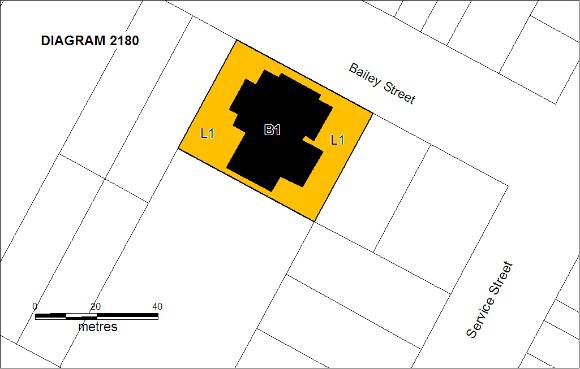
Location98 BAILEY STREET CLUNES, HEPBURN SHIRE
File Number601172LevelRegistered |
|




Statement of Significance
What is significant?
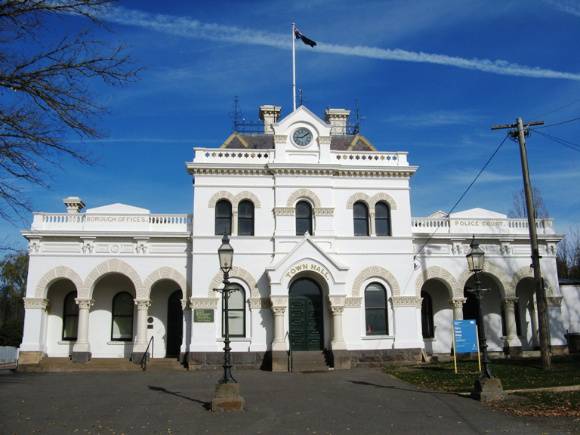
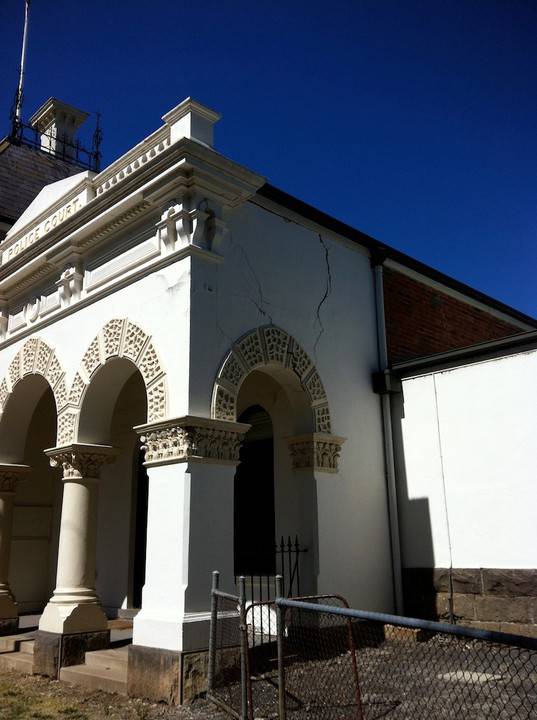
The Clunes Town Hall and Court House was designed by Percy Oakden and
constructed by William Cowland in 1872-3. The distinctive Victorian
Free Classical style building is a reflection of the civic pride and
community confidence of a gold town at the peak of its prosperity. In July 1851 it was announced that payable gold had been discovered
near Clunes. Clunes' fortunes fluctuated during the early 1850s and it
was not until the Port Phillip and Colonial Gold Mining Company began
quartz crushing operations that the town experienced significant
development. The township of Clunes was surveyed in 1858 and in 1861,
Allotment 7 of Section 4 was temporarily reserved for municipal
purposes for the newly proclaimed Borough of Clunes. Architect Percy
Oakden was appointed to produce a design for the Town Hall, Borough
Offices and Court House in late 1871. A grant of £2100 from the
Victorian Government to the Clunes Borough Council for a court house,
tied to a 999 year lease, provided sufficient funds to construct a
substantial civic building. The foundation stone was laid by the Chief
Secretary of Victoria, Charles Gavan Duffy in April 1872 and the Town
Hall opened in May 1873. Oakden's design was for a symmetrical building, with the Borough
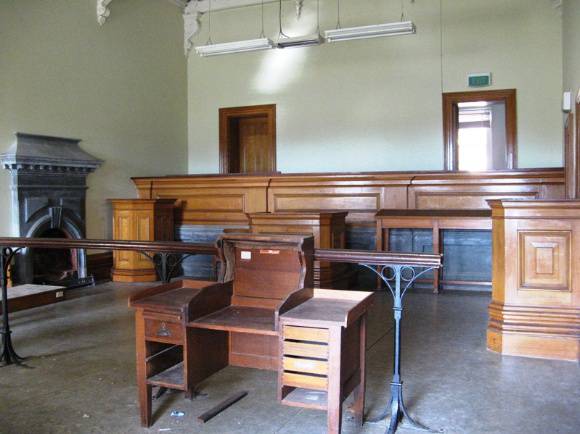
offices and Police Court flanking the two-storeyed central hall. The
Police Court consists of court room, barrister's office and holding
cell on the lower level and clerks' and magistrate's offices on an
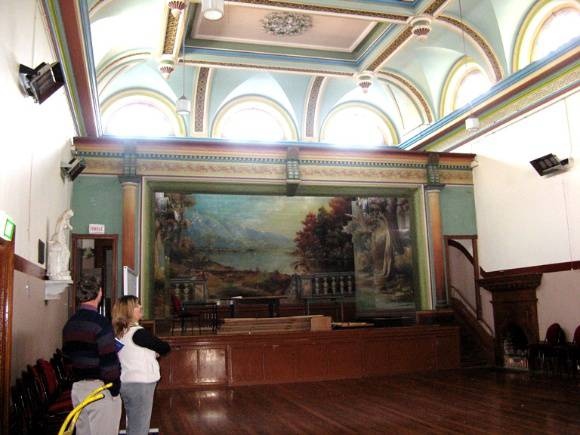
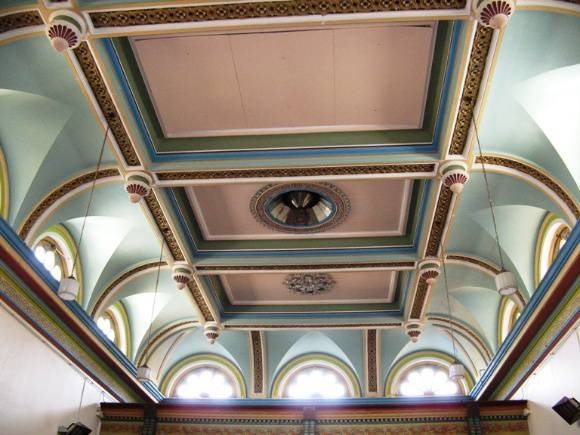
upper level. Much of its original furniture is extant. The lavish main
hall is of particular note, with its decorative ceiling, lunette
windows and stage. The Town Hall was the centre of social functions
for nearly a century, and modifications to the building to accommodate
entertainment include the early dressing rooms, the 1916 stage
remodelling to include proscenium arch, backdrops and curtain painted
by Richard Ford, the modifications for the screening of picture shows
and the relocation of the Bible Christian Church for use as the Supper
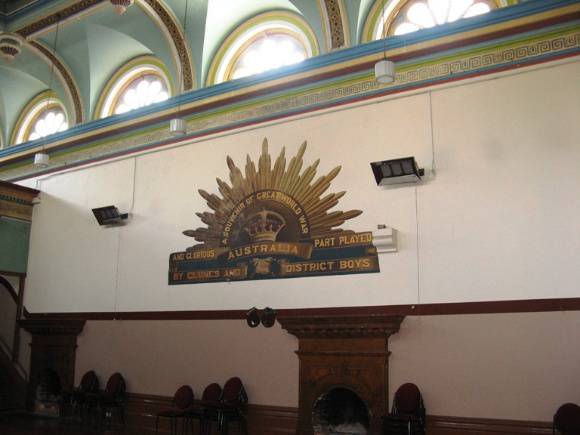
Room. The building was a symbolic centre for community loyalty and sense of
belonging, evidenced by the large World War I memorial on the western
wall of the main hall. The memorial consisted of the painted rising
sun by Richard Ford and the collection of 152 individual photographs
of local servicemen and women, which originally hung alongside it. In December 1982, the Government revoked the appointment of the
Clunes Court House during a period of rationalisation of court
facilities. With the amalgamation of the Borough of Clunes and the
Shire of Talbot, the Clunes Town Hall was no longer the location of
municipal operations. Though with the growth in car usage and changing
tastes in entertainment, the Town Hall gradually became less of a
focus for community functions and leisure activities, it remains a
significant place for the township of Clunes.
How is it significant?
The Clunes Town Hall and Court House is of historical and
architectural significance to the State of Victoria.
Why is it significant?
Clunes Town Hall and Court House is of historical significance as a
civic building constructed at the height of a gold town's prosperity,
demonstrating the confidence that such towns had in their future. The town hall is of historical and architectural importance in
demonstrating the continuing role that such municipal buildings played
in the civic and social life of rural townships in the late nineteenth
and early twentieth century. The World War I memorial and associated
photographs demonstrate the importance of the place to the Clunes
community and is of historical significance. The adaptation of the
main hall for entertainment purposes, to accommodate stage productions
and film screenings, is of historical significance in demonstrating
the development of cultural facilities in rural communities. The collection of objects associated with the Clunes Town Hall is of
historical significance in demonstrating the judicial, municipal and
cultural usages of the building. The collection of in situ
original Court House furniture is of particular note. The Clunes Town Hall and Court House is of architectural significance
as a striking and eclectic municipal building design by Percy Oakden,
and a rare rural example of a combined Court House and Town Hall. The Clunes Town Hall and Court House is significant to the State of
Victoria in demonstrating the importance of civic buildings and
government institutions to rural community life and the aspirations of
newly established gold rush towns wishing to assert their status and
wealth. The Clunes Town Hall and Court House was adapted to
accommodate many developments in the cultural and social life of
Clunes, including entertainment, commemoration and community
functions, which contribute to its significance.
Group
Community Facilities
Category
Hall Town Hall