
| Back to search results » | Back to search page » |


|
Orion, Geoffrey Bartlett
Location428-430 St Kilda Road MELBOURNE, MELBOURNE CITY
File NumberB7690LevelState |
|




Statement of Significance
What is significant?
The sculpture Orion by Geoffrey Bartlett was commissioned in
2008 by the property development group, Lustig and Moar, in response
to an initiative of the Melbourne City Council and the Victorian
Ministry of the Arts to improve public spaces in central Melbourne by
the inclusion of "large scale sculptures and works of art".
St. Kilda Road was already the site for major sculptural works by
notable Australian sculptors including Bartlett himself, whose sculpture, The Messenger, (1983) had
been installed in the moat of the National Gallery. Max Moar, the CEO
of Lustig and Moar, approached Geoffrey Bartlett to produce a design
to enhance the streetscape of their new apartment block at 428-430 St.
Kilda Road. Following the presentation of a maquette, Moar, approved
the sum of $120,000 dollars to cover the cost of the completion of the
work, which was to be sited at the St. Kilda road entrance to the
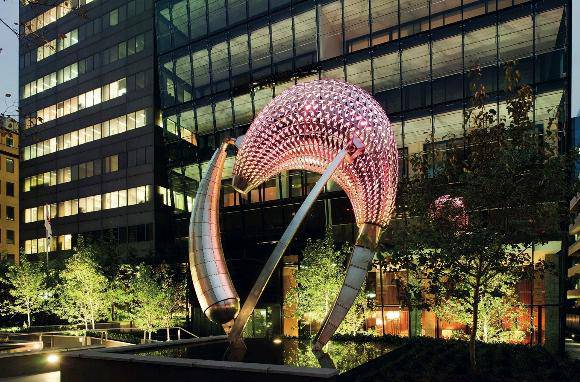
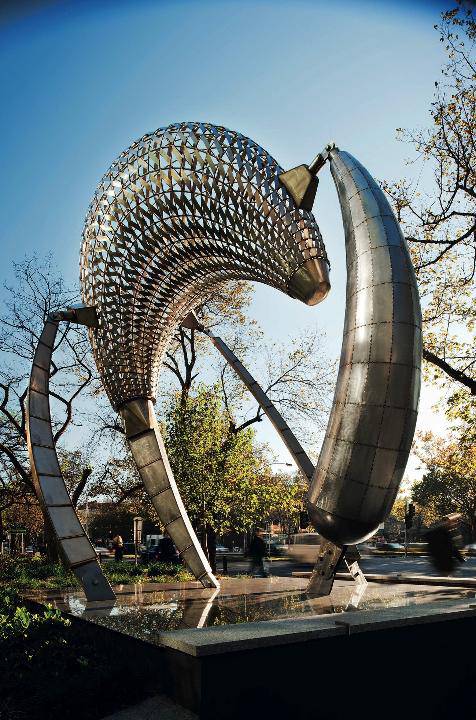
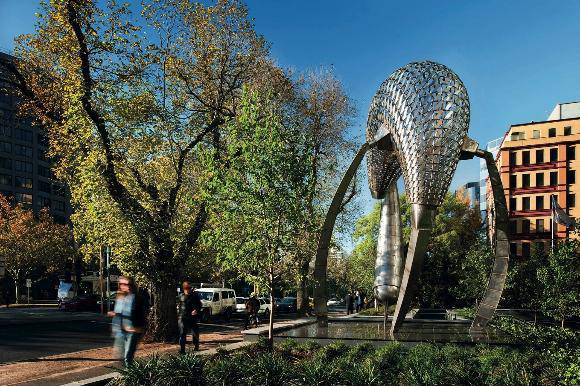
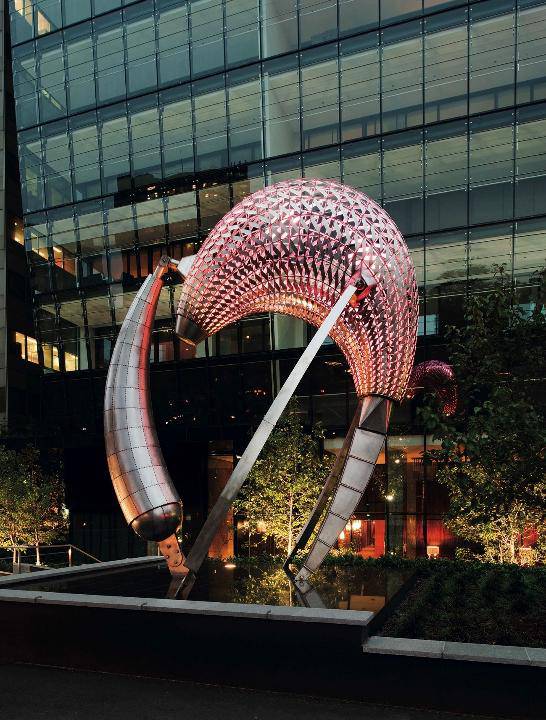
apartment block, now known as the 'Lucient' building. Orion is seven metres high and five metres wide, and is positioned on
a square slab of polished granite. It is constructed in 2B grade
stainless steel, which has a high lustre, reflective surface. The
rotation for the placement of the sculpture was carefully considered
for viewing from all directions, including from the apartments above.
The two interrelating, curving cylindrical forms with tapering ends
arc towards and support each other. The larger, crescent-shaped form
is held aloft by three flat, panelled, tapering blade-like supports.
The smaller curving form is composed of solid steel panels with
expressed construction details and joints. The two curved forms
enclose and define the space and provide energetic momentum to the
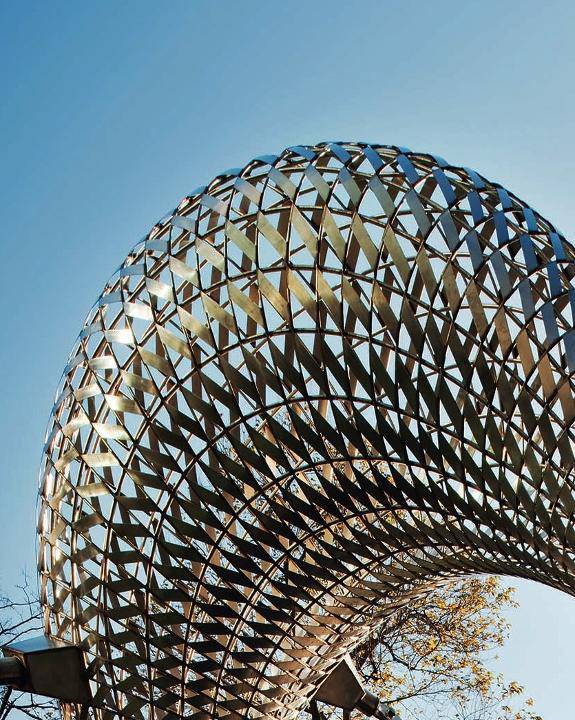
whole work. The larger form is constructed as an open steel cage with
horizontal and circular steel bands drawn together at both ends, and
enclosed by solid cylindrical steel "cans" which conceal the
hidden lighting. A complex arrangement of individually cut and angled
steel blades positioned within the cage enhance natural light by day,
and maximise reflection from the lights at night. The resolution of
the concealed, rotating lighting presented an enormous technical and
design challenge. In darkness the supporting structure appears to
disappear leaving the two forms hovering, like coloured projectiles in
the night sky.
How is it significant?
The sculpture Orion (2008) by Geoffrey Bartlett is significant
for aesthetic and cultural reasons at State level (Criteria a, c, e,
& h).
Why is it significant?
The sculpture Orion is significant to Victoria for aesthetic
reasons: criteria (c), (e) and (h). Orion refines and extends
the aesthetic vocabulary and craftsmanship displayed by Bartlett in
earlier sculptural works, and specifically in his most recent public
work, Aurora, situated at the Melbourne docklands area. It
exemplifies sculptural themes that have been refined during more than
thirty years of establishing his position as a major artistic force
within Victoria, Australia and internationally. His work is
extensively represented in National and State public art galleries and
many major private collections. Geoffrey Bartlett has completed
significant public works of art within Australia. These include:
The Messenger (1983) for the National Gallery of Victoria,
Beacon (1998/99) for Newcastle City Council, Fusion
(2000) for the Australian National University, Canberra and
Aurora (2006) for Melbourne City Council. He has exhibited
regularly with at least twenty major solo exhibitions including:
Deakin University (2001), the National Gallery of Victoria (2007) and
the McClelland Gallery (2015). Bartlett's sculptures embody a complex
form of tension and visual balance and harmony. These sculpturally
realized attributes are strikingly evident in Orion. Geoffrey Bartlett's sculpture Orion is significant to Victoria
at a cultural level: criteria (a), and (h). This sculpture, as with
his former work, is influenced by, and reflects, his strong cultural
background, particularly derived from his early experiences in rural
Victoria. Born in Melbourne in 1952, he spent his early life in
Warrnambool and Shepparton where family and friends and the
acquisition of rural craft skills were important influences on the
formative development of his subsequent three-dimensional artworks.
Bartlett continued his education at RMIT University, Melbourne before
being awarded a scholarship by the Ian Potter Sculpture Commission
(1982), followed by the award of a Harkness Fellowship (1983) for
further study at Columbia University, New York. Although responsive to
the external influences of major international artists and sculptors
including David Smith, Henry Moore and Isamu Noguchi, his work has
continued to develop and demonstrate his cultural ties to his
Australian heritage and the respect he acquired during his early rural
background for craftsmanship, materials and technology. Orion
imaginatively explores themes relevant to the Orion Constellation and
its location in the Southern sky. St. Kilda Road where the sculpture is situated is a major
thoroughfare leading to the heart of the Melbourne CBD. It is a
recognised cultural environment due to the siting of the Shrine of
Remembrance, the National Gallery of Victoria, the State Theatre and
Concert Hall and other sculptural works by many notable artists.
Orion is a feat of aesthetic achievement, craftsmanship and
technical innovation, which enhances this cultural environment. As
such it is of significant importance to the State of Victoria and
deserves protection.
Group
Public Art
Category
Banner