
| Back to search results » | Back to search page » |


|
HV MCKAY OFFICES
Location2 DEVONSHIRE ROAD SUNSHINE, BRIMBANK CITY
File Number13/006774-01LevelRegistered |
|




Statement of Significance
What is significant? In 1930, HV McKay, Australia?s biggest manufacturer of farm machinery
merged with Massey Harris, the largest farm implement makers in Canada
and major international exporters. The directorship remained in McKay
family hands. In 1940 the engineering section and the garage buildings
behind were revamped to a design by architect Frederick Morsby. The
engineering department drawing section was accommodated in a two
storey continuation of the east wing of the 1926 building, though with
some additional Moderne styling on the section over the vehicular
entrance to the courtyard behind the offices. The tall new garage
facade to the railway frontage was given similarly derivative detailing. Massey-Harris amalgamated with Harry Ferguson in 1953, and the McKay
family interest was bought out by this company in 1955. The Sunshine
factory became a part of the international company Massey-Harris
Ferguson. This takeover had a major impact on the McKay family and
their staff. The timberwork and furniture of the office building,
which was now no longer the head office of the company, was painted
over in Massey Ferguson grey. The main centre of tractor and self
propelled harvester production was now in England, and Sunshine become
the second largest plant in the company?s network. A new
administration building with clock tower was constructed across
Devonshire Road in 1956. The operation of the works was greatly scaled
down in 1971, and much of the factory site was sold in 1986. The 1909 office building was of single storey masonry construction
decorated in an Edwardian Baroque/Arts and Crafts style. The architect
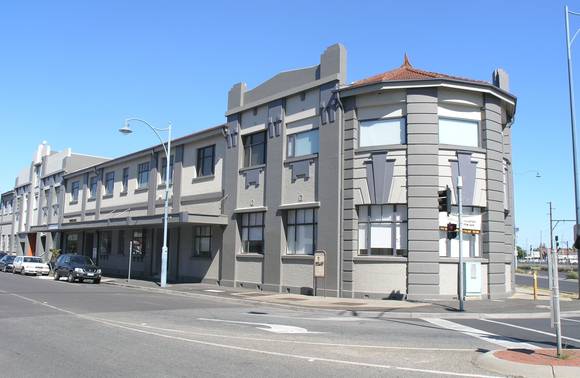
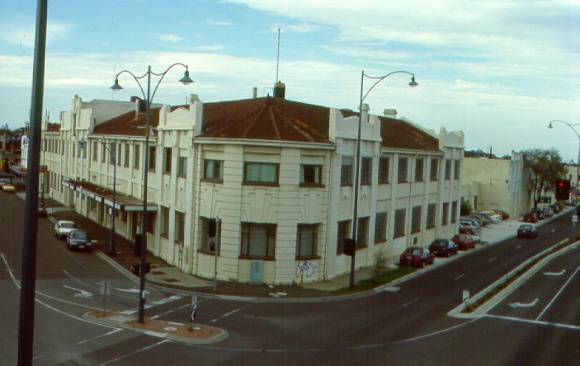
is unknown. The 1926 office building was designed in a rusticated
classical style by architect J. Raymond Robinson, who also undertook
housing designs in Sunshine. The two storey stuccoed masonry building
has a gabled Marseille tiled roof with narrow eaves. The straight
sections of facade to Devonshire Road and Harvester Road are flanked
by stuccoed bays with pilasters and pediment continued above eaves
height to form panels that once carried the McKay company name. The
corner is turned by three window bays separated by wide rusticated
pilasters. Massive rusticated voussoirs jut out over the first floor
corner windows. The awning over the main entrance on Devonshire Street
was finished with decorative elements in keeping with the facade. The
entrance hall is gained by a narrow and deeply inset timber panelled
revolving door, which leads to a two-storey space with surrounding
timber-panelled staircase. At first floor level the corner section of
the building contains executive offices and the timber panelled
boardroom with its commanding view over the factory and railway lines
and sidings. How is it significant? Why is it significant? The McKay Offices at Sunshine are of historical significance as one
of the very few surviving elements of the McKay ? Massey Ferguson
factory complex, which was one of Australia's largest and most active
industrial plants and employers of labour, and which made a major
contribution to community life in Melbourne's western suburbs. The
office building entrance faces the gates which once opened onto
Russell Street, and now forms part of a precinct of structures
relating to the various aspects and phases of the McKay enterprise,
including the Russel Street gates, the 1956 clock tower, the railway
footbridge and the H V McKay Memorial Gardens. The McKay Offices at Sunshine are of architectural significance as
early twentieth century examples of the building type of
administration/office buildings associated with large industrial works.
HV McKay purchased the Braybrook Implement
Company works, on an advantageous site at the junction of the northern
and western rail routes, in 1904. He began to transfer his operations
there from Ballarat in 1905 and completed the move in 1907, by which
time the works had trebled in size. Braybrook Junction was renamed
Sunshine in 1907. At first the office of the company was in the
buildings on the north side of Devonshire Road. The new office
building on the triangular block to the south of Devonshire Road was
constructed facing the railway line in 1909, and the area around this
corner became the site of all of the later head office activity for
the company. The general pattern of factory building expansion was to
the north. Timber framed buildings of similar scale and style to the
1909 office were constructed on either side in 1910-11. The area just
to the east was occupied by factory roofed spaces for the spare parts
and engineering departments. New factory offices, show rooms and a
clocktower were opened on the north side of Devonshire Road in 1921.
By 1926, the year HV McKay died, the factory occupied an area of 80
acres. The new Head Office building on the corner was then being
designed, and was completed in the same year. The 1909 office now
became the printing area, where company publications were produced.
The new offices became the focus for the numerous important visitors
to the factory, who were commonly photographed outside the main doors.
Tour groups were photographed with the corner of the building as a
backdrop, and the offices were also a regular backdrop for photos of
the various new models of machinery. In 1928 McKay?s original timber
slab farm smithy was relocated on the strip of garden facing the
railway line.
The McKay Offices at Sunshine are of
historical and architectural significance to the State of Victoria.
The McKay Offices at Sunshine are of
historical significance for their association with the activities of
Hugh Victor McKay (1865-1926) and of the McKay family enterprise.
McKay was famous for producing, manufacturing and exporting on a large
scale one of Australia's best known pieces of agricultural machinery,
the "Sunshine" harvester. McKay became one of Australia's
foremost industrial entrepreneurs, a leader in the fight for tariff
protection, and the head of the Chamber of Manufacturers. The
buildings became the most public face of the McKay firm and the later
companies.
Group
Commercial
Category
Office building