
| Back to search results » | Back to search page » |


|
LIBRARY OF THE SUPREME COURT
Other NameSUPREME COURT LIBRARY Location210 WILLIAM STREET MELBOURNE, MELBOURNE CITY
File Number11/003300-01 - 03 [ Documents only relating to H1514, H1477, H1478, and H1476 - see file note]LevelRegistered |
|




Statement of Significance
What is significant?
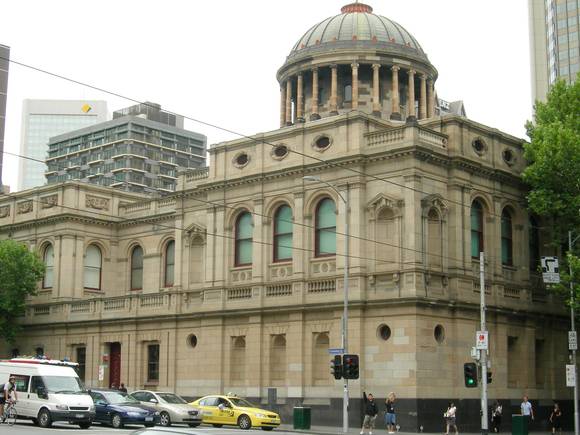
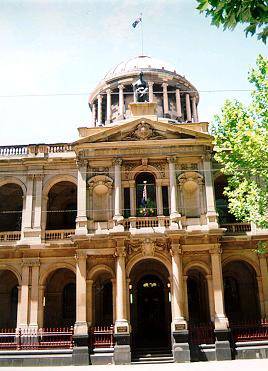
The Library of the Supreme Court is part of a complex of buildings known as the Melbourne Law Courts, 192-228 William Street. Alfred L Smith and Arthur E Johnson won the design competition in 1873 for the Courts and Library and prepared the working drawings. J J Clark and Peter Kerr, architects at the Public Works Department, undertook the detailed drawings and also supervised the works. Erected between 1874 and 1884, the Law Courts are constructed in brick on bluestone foundations and faced with Tasmanian freestone. The library is a freestanding structure within the central quadrangle of the Law Courts and is symmetrical in plan. Internally the library dome has a diameter of 16.8 metres. The shallow copper-clad dome is supported by twenty-four Ionic columns sat on a drum. The dome was once a landmark on the city's western skyline. The three storey chamber is linked to surrounding rooms and reading alcoves by columned archways. The upper level has a circular gallery with a cast iron balustrade.
How is it significant?
The Library of the Supreme Court is of architectural, historical and social significance to the State of Victoria.
Why is it significant?
The Library of the Supreme Court is architecturally significant as one of the most finely designed and executed public buildings in Australia. Whilst stylistically characteristic of the work of architect A E Johnson, it is his finest work. It was possibly modelled on the Dome of the Four Courts in Dublin designed by James Gandon. Internally the cylindrical plan with dome and the superb quality and design of the plaster finishes makes the library one of the greatest of Melbourne's interior spaces.
The Library of the Supreme Court is historically significant as a landmark building in the western part of the city, now partially obscured from some sides by twentieth century development. It is significant for its origins in a design competition in 1873 that scandalised the architectural profession, due to the close professional relationship between one of the assessor's, George Johnson, and the winner Alfred Smith.
The Library of the Supreme Court is socially significant as part of one of the most important nineteenth century public buildings in Melbourne, and as part of the premier Law Courts in Victoria.
Group
Law Enforcement
Category
Other - Law Enforcement