
| Back to search results » | Back to search page » |


|
BOROONDARA GENERAL CEMETERY
Other NamesKEW CEMETERY , BOROONDARA CEMETERY Location430-440 HIGH STREET KEW, BOROONDARA CITY
File NumberHER/1999/000252LevelRegistered |
|




Statement of Significance
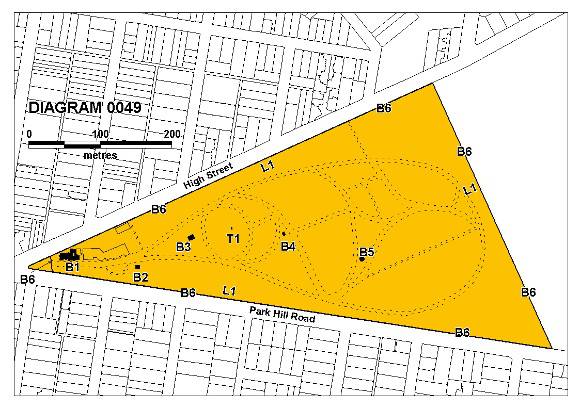
What is significant? Boroondara Cemetery, established in 1858, is within an unusual
triangular reserve bounded by High Street, Park Hill Road and Victoria
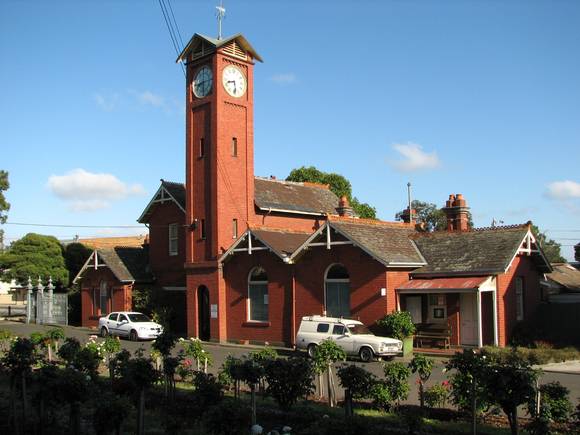
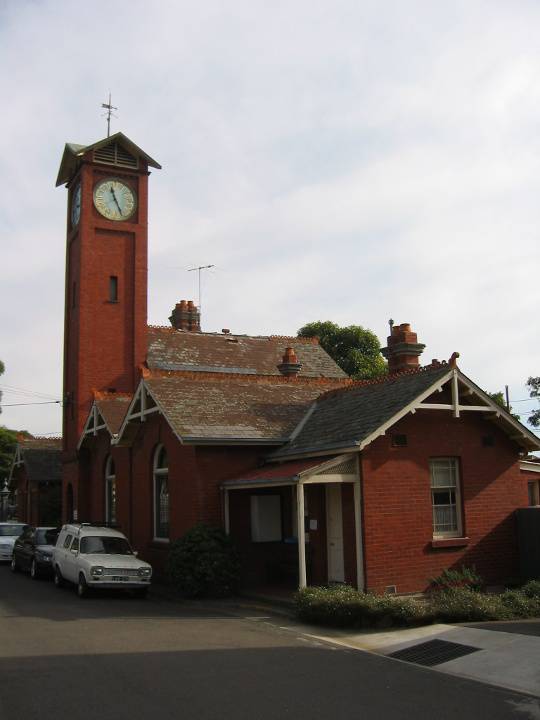
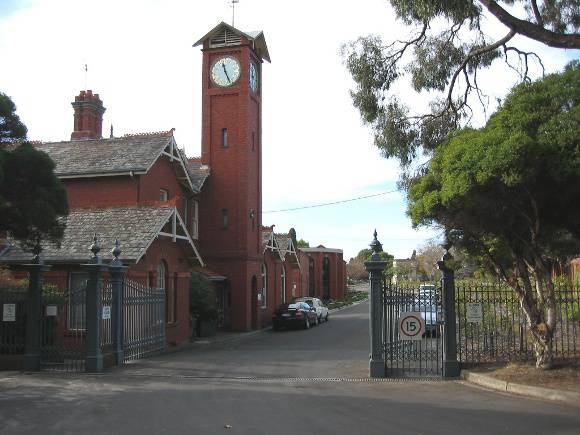
Park, Kew. The caretaker's lodge and administrative office (1860
designed by Charles Vickers, additions, 1866-1899 by Albert Purchas)
form a picturesque two-storey brick structure with a slate roof and
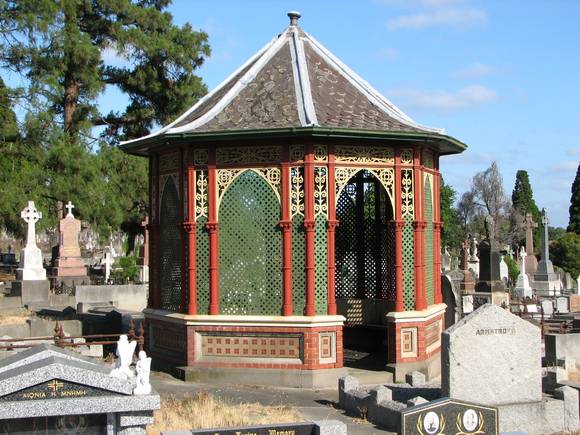
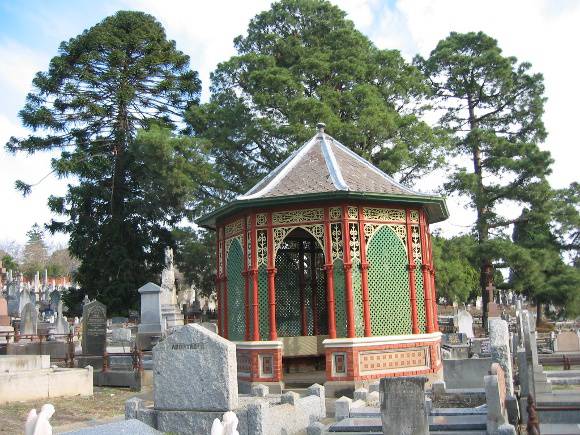
clock tower. A rotunda or shelter (1890, Albert Purchas) is located in
the centre of the cemetery: this has an octagonal hipped roof with
fish scale slates and a decorative brick base with a tessellated floor
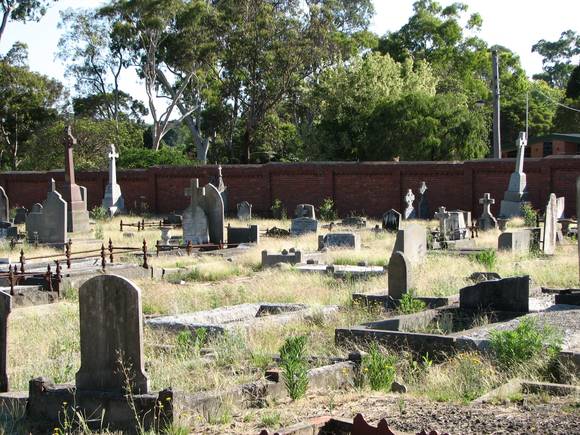
and timber seating. The cemetery is surrounded by a 2.7 metre high
ornamental red brick wall (1895-96, Albert Purchas) with some sections
of vertical iron palisades between brick pillars. Albert Purchas was a
prominent Melbourne architect who was the Secretary of the Melbourne
General Cemetery from 1852 to 1907 and Chairman of the Boroondara
Cemetery Board of Trustees from 1867 to 1909. He made a significant
contribution to the design of the Boroondara Cemetery Boroondara Cemetery is an outstanding example of the Victorian Garden
Cemetery movement in Victoria, retaining key elements of the style,
despite overdevelopment which has obscured some of the paths and
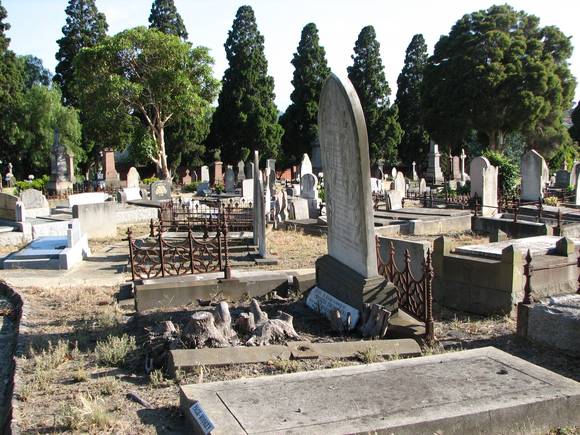
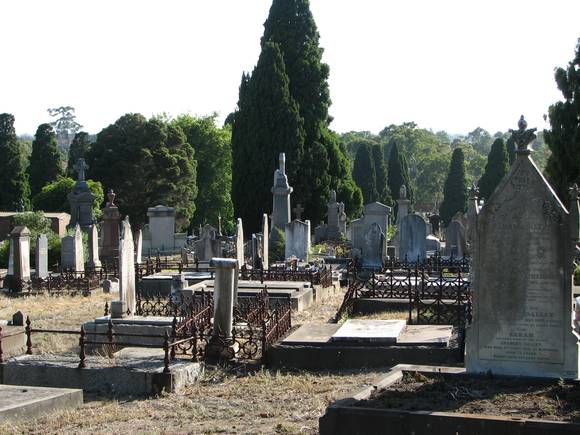
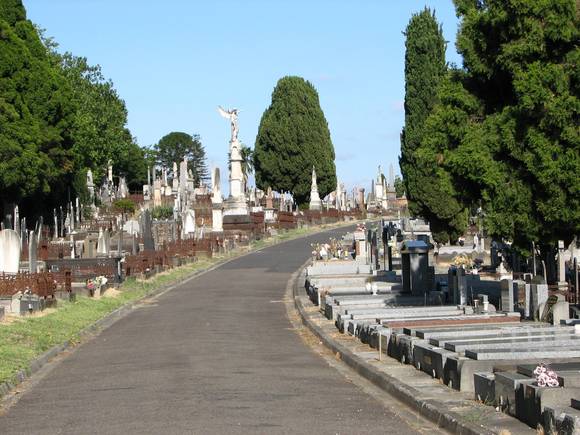
driveways. Elements of the style represented at Boroondara include an
ornamental boundary fence, a system of curving paths which are kerbed
and follow the site's natural contours, defined views, recreational
facilities such as the rotunda, a landscaped park like setting,
sectarian divisions for burials, impressive monuments, wrought and
cast iron grave surrounds and exotic symbolic plantings. In the 1850s
cemeteries were located on the periphery of populated areas because of
concerns about diseases like cholera. They were designed to be
attractive places for mourners and visitors to walk and contemplate.
Typically cemeteries were arranged to keep religions separated and
this tended to maintain links to places of origin, reflecting a
migrant society. Other developments included cast iron entrance gates, built in 1889
to a design by Albert Purchas; a cemetery shelter or rotunda, built in
1890, which is a replica of one constructed in the Melbourne General
Cemetery in the same year; an ornamental brick fence erected in
1896-99(?); the construction and operation of a terminus for a horse
tram at the cemetery gates during 1887-1915; and the Springthorpe
Memorial built between 1897 and 1907. A brick cremation wall and a
memorial rose garden were constructed near the entrance in the mid-
twentieth century(c.1955-57) and a mausoleum completed in 2001.The
maintenance shed/depot close to High Street was constructed in 1987.
The original entrance was altered in 2000 and the original cast iron
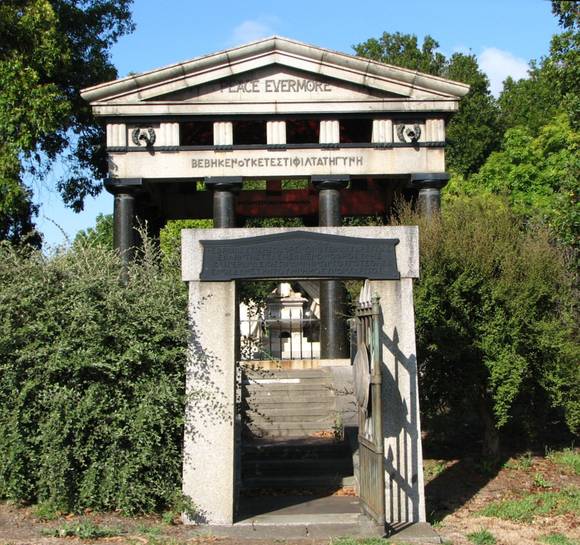
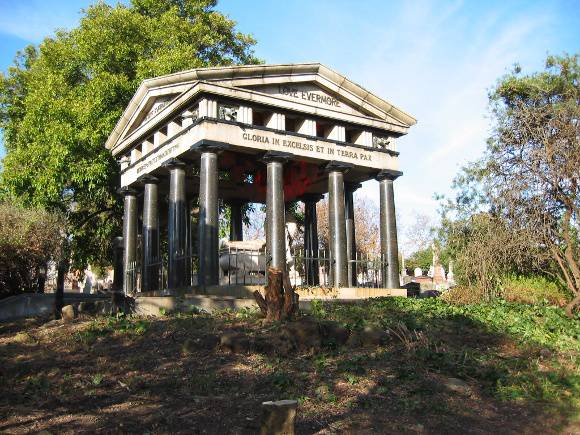
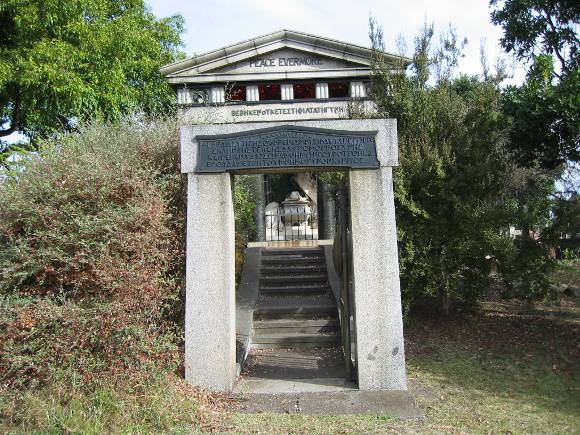
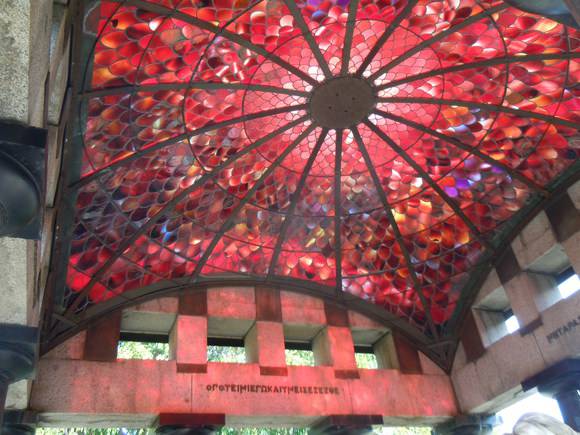
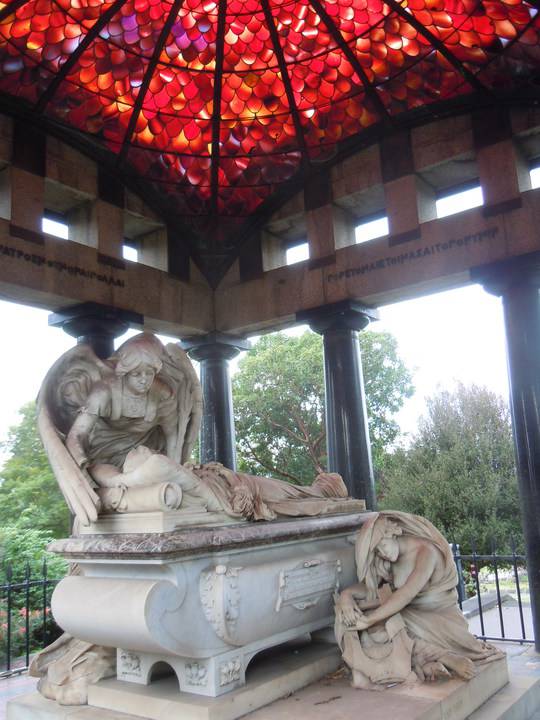
gates moved to the eastern entrance of the Mausoleum. The Springthorpe Memorial (VHR 522) set at the entrance to the burial
ground commemorates Annie Springthorpe, and was erected between 1897
and 1907 by her husband Dr John Springthorpe. It was the work of the
sculptor Bertram Mackennal, architect Harold Desbrowe Annear,
landscape designer and Director of the Melbourne Bortanic Gardens,
W.R. Guilfoyle, with considerable input from Dr Springthorpe The
memorial is in the form of a small temple in a primitive Doric style.
It was designed by Harold Desbrowe Annear and includes Bertram
Mackennal sculptures in Carrara marble. Twelve columns of deep green
granite from Scotland support a Harcourt granite superstructure. The
roof by Brooks Robinson is a coloured glass dome, which sits within
the rectangular form and behind the pediments. The sculptural group
raised on a dais, consists of the deceased woman lying on a
sarcophagus with an attending angel and mourner. The figure of Grief
crouches at the foot of the bier and an angel places a wreath over
Annie's head, symbolising the triumph of immortal life over death. The
body of the deceased was placed in a vault below. The bronze work is
by Marriots of Melbourne. Professor Tucker of the University of
Melbourne composed appropriate inscriptions in English and archaic
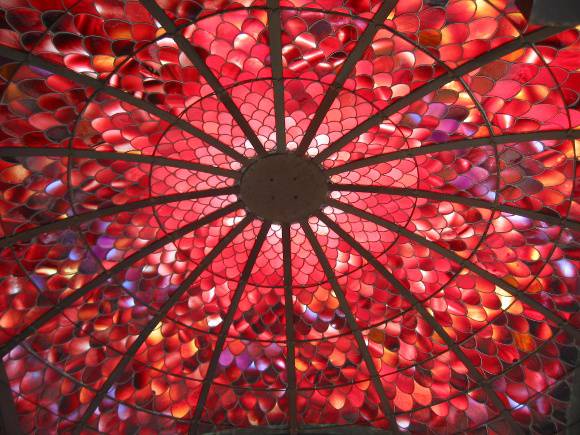
Greek lettering.. The floor is a geometric mosaic and the glass dome
roof is of Tiffany style lead lighting in hues of reds and pinks in a
radiating pattern. The memorial originally stood in a landscape
triangular garden of about one acre near the entrance to the cemetery.
However, after Dr Springthorpe's death in 1933 it was found that
transactions for the land had not been fully completed so most of it
was regained by the cemetery. A sundial and seat remain. The building
is almost completely intact. The only alteration has been the removal
of a glass canopy over the statuary and missing chains between posts.
The Argus (26 March 1933) considered the memorial to be the most
beautiful work of its kind in Australia. No comparable buildings are
known.
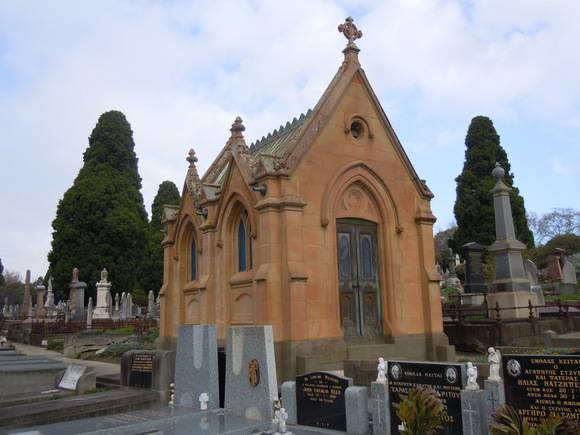
The Cussen Memorial (VHR 2036) was constructed in 1912-13 by Sir Leo
Cussen in memory of his young son Hubert. Sir Leo Finn Bernard Cussen
(1859-1933), judge and member of the Victorian Supreme Court in 1906.
was buried here. The family memorial is one of the larger and more
impressive memorials in the cemetery and is an interesting example of
the 1930s Gothic Revival style architecture. It takes the form of a
small chapel with carvings, diamond shaped roof tiles and decorated
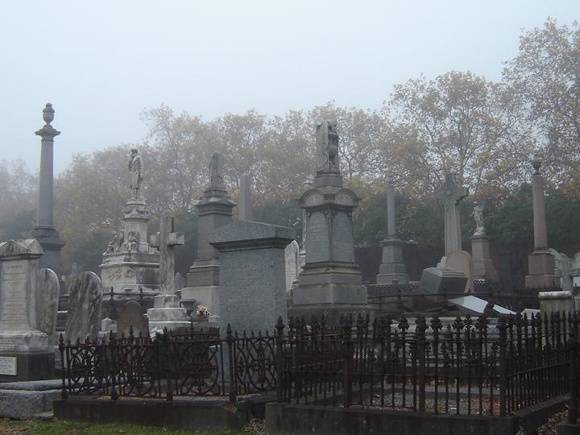
ridge embellishing the exterior. By the 1890s, the Boroondara Cemetery was a popular destination for
visitors and locals admiring the beauty of the grounds and the
splendid monuments. The edge of suburban settlement had reached the
cemetery in the previous decade. Its Victorian garden design with
sweeping curved drives, hill top views and high maintenance made it
attractive. In its Victorian Garden Cemetery design, Boroondara was
following an international trend. The picturesque Romanticism of the
Pere la Chaise garden cemetery established in Paris in 1804 provided a
prototype for great metropolitan cemeteries such as Kensal Green
(1883) and Highgate (1839) in London and the Glasgow Necropolis
(1831). Boroondara Cemetery was important in establishing this trend
in Australia. The cemetery's beauty peaked with the progressive completion of the
spectacular Springthorpe Memorial between 1899 and 1907. From about
the turn of the century, the trustees encroached on the original
design, having repeatedly failed in attempts to gain more land. The
wide plantations around road boundaries, grassy verges around clusters
of graves in each denomination, and most of the landscaped surround to
the Springthorpe memorial are now gone. Some of the original road and
path space were resumed for burial purposes. The post war period saw
an increased use of the Cemetery by newer migrant groups. The mid- to
late- twentieth century monuments were often placed on the grassed
edges of the various sections and encroached on the roadways as the
cemetery had reached the potential foreseen by its design. These were
well tended in comparison with Victorian monuments which have
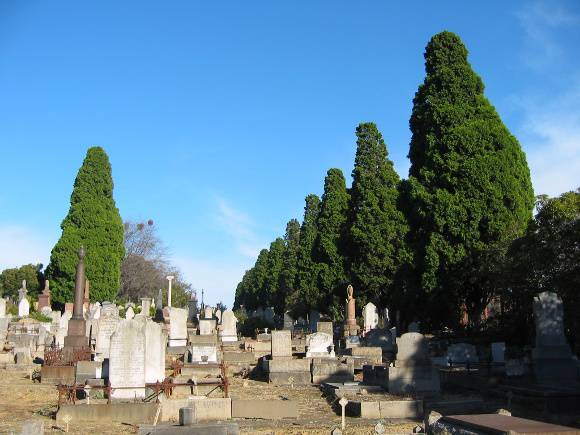
generally been left to fall into a state of neglect. The Boroondara Cemetery features many plants, mostly conifers and
shrubs of funerary symbolism, which line the boundaries, road and
pathways, and frame the cemetery monuments or are planted on graves.
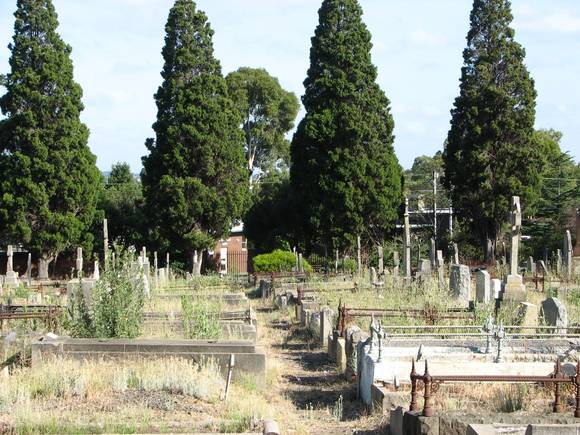
The major plantings include an impressive row of Bhutan Cypress
(Cupressus torulosa), interplanted with Sweet Pittosporum (Pittosporum
undulatum), and a few Pittosporum crassifolium, along the High Street
and Parkhill Street, where the planting is dominated by Sweet Pittosporum. Planting within the cemetery includes rows and specimen trees of
Bhutan Cypress and Italian Cypress (Cupressus sempervirens), including
a row with alternate plantings of both species. The planting includes
an unusual "squat" form of an Italian Cypress. More of these
trees probably lined the cemetery roads and paths. Also dominating the
cemetery landscape near the Rotunda is a stand of 3 Canary Island
Pines (Pinus canariensis), a Bunya Bunya Pine (Araucaria bidwillii)
and a Weeping Elm (Ulmus glabra 'Camperdownii') Amongst the planting are the following notable conifers: a towering
Bunya Bunya Pine (Araucaria bidwillii), a Coast Redwood (Sequoia
sempervirens), a rare Golden Funeral Cypress (Chamaecyparis funebris
'Aurea'), two large Funeral Cypress (Chamaecyparis funebris), and the
only known Queensland Kauri (Agathis robusta) in a cemetery in Victoria. The Cemetery records, including historical plans of the cemetery from
1859, are held by the administration and their retention enhances the
historical significance of the Cemetery. How is it significant? Why is it significant? The Boroondara Cemetery is of historical significance as a record of
Victorian life from the 1850s, and the early settlement of Kew. It is
also significant for its ability to demonstrate, through the design
and location of the cemetery, attitudes towards burial, health
concerns and the importance placed on religion, at the time of its
establishment. The Boroondara Cemetery is of architectural significance for the
design of the gatehouse or sexton's lodge and cemetery office (built
in stages from 1860 to 1899), the ornamental brick perimeter fence and
elegant cemetery shelter to the design of prominent Melbourne
architects, Charles Vickers (for the original 1860 cottage) and Albert
Purchas, cemetery architect and secretary from 1864 to his death in
1907. The Boroondara Cemetery has considerable aesthetic significance which
is principally derived from its tranquil, picturesque setting; its
impressive memorials and monuments; its landmark features such as the
prominent clocktower of the sexton's lodge and office, the mature
exotic plantings, the decorative brick fence and the entrance gates;
its defined views; and its curving paths. The Springthorpe Memorial
(VHR 522), the Syme Memorial and the Cussen Memorial (VHR 2036), all
contained within the Boroondara Cemetery, are of aesthetic and
architectural significance for their creative and artistic achievement. The Boroondara Cemetery is of scientific (botanical) significance for
its collection of rare mature exotic plantings. The Golden Funeral
Cypress, (Chamaecyparis funebris 'Aurea') is the only known example in Victoria. The Boroondara Cemetery is of historical significance for the graves,
monuments and epitaphs of a number of individuals whose activities
have played a major part in Australia's history. They include the
Henty family, artists Louis Buvelot and Charles Nuttall, businessmen
John Halfey and publisher David Syme, artist and diarist Georgiana
McCrae, actress Nellie Stewart and architect and designer of the
Boroondara and Melbourne General Cemeteries, Albert Purchas.
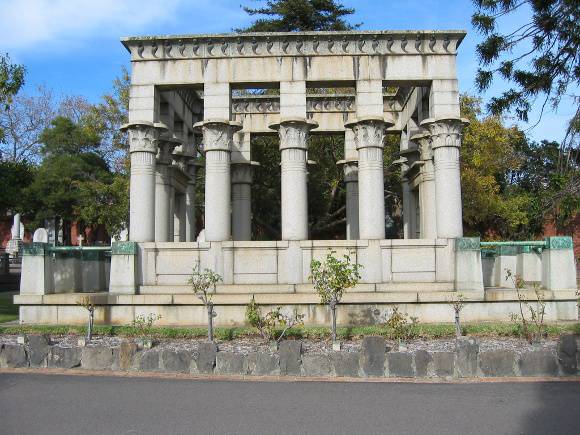
The Syme Memorial (1908) is a memorial to David Syme, political
economist and publisher of the Melbourne Age newspaper. The Egyptian
memorial designed by architect Walter Richmond Butler is one of the
most finely designed and executed pieces of monumental design in
Melbourne. It has a temple like form with each column having a
different capital detail. These support a cornice that curves both
inwards and outwards. The tomb also has balustradings set between
granite piers which create porch spaces leading to the entrance ways.
Two variegated Port Jackson Figs are planted at either end.
Boroondara Cemetery is of aesthetic,
architectural, scientific (botanical) and historical significance to
the State of Victoria.
The Boroondara Cemetery is of historical
and aesthetic significance as an outstanding example of a Victorian
garden cemetery.
Group
Cemeteries and Burial Sites
Category
Cemetery Gates/Fences