
| Back to search results » | Back to search page » |


|
FERGUSONS BRIDGE
LocationOVER CAMPASPE RIVER, BENDIGO-MURCHISON ROAD GOORNONG AND RUNNYMEDE, GREATER BENDIGO CITY, CAMPASPE SHIRE
File NumberHER/1999/000132LevelRegistered |
|




Statement of Significance
What is significant?
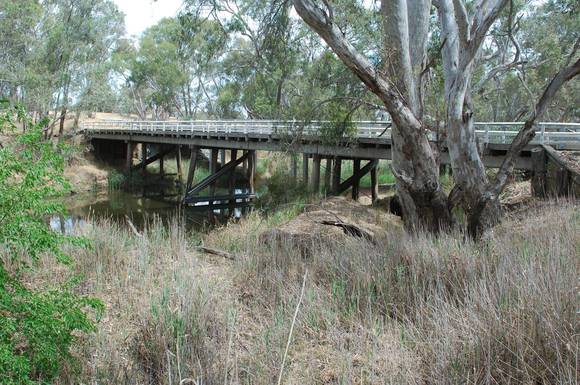
Fergusons Bridge is a four-span composite timber and steel road bridge with graceful curving timber deck, situated on the Bendigo-Murchison Road over the Campaspe River, approximately 4 kilometres east of the Midland Highway. It utilises rolled-steel joists seated upon conventional driven-pile timber piers, and features a rare super-elevated curved timber deck 56 metres long and 7.1 metres wide. Span lengths between timber piers average 13.8 metres. It was constructed by the Country Roads Board in 1939. It is situated on the farming plains of northern Victoria, among large red river gums on a spacious river bank reserve along the Campaspe River. It is currently in regular use as a VicRoads Main Road bridge.
How is it significant?
Fergusons Bridge is of scientific (technical) and historical significance to Victoria.
Why is it significant?
Fergusons Bridge is of scientific (technical) significance as a very rare curved-deck timber and steel road-over-river bridge representative of the post-Depression/pre-World War 2 era of Victorian transport history when rapidly increasing numbers of motor vehicles forced road authorities to abandon traditional bridge designs more suitable to horse-drawn vehicles. Before the beginning of the motor era timber bridges were, almost without exception, built at right angles to the stream, often involving a sharp change of direction between the road and the bridge. During the 1920s and 1930s, the CRB increasingly built timber bridges on skew alignments to cater for faster-moving motor vehicles and in a few instances even built timber-decked bridges on a curved alignment. By the Second World War super-elevated bridge designs had been introduced, providing banking of the deck surface to counteract the centrifugal force on turning vehicles, however the combination of super-elevation with a curved timber deck remained quite rare. Ferguson’s Bridge is the oldest surviving example of a timber curved and super-elevated bridge in Victoria. Very few curved and super-elevated composite road bridges with timber decks appear ever to have existed in this State; the only three other known surviving examples have been substantially rebuilt. Of four spans, with a deck width of 7.1 metres and a maximum span of 13.8 metres, it is of above average size for a composite steel and timber bridge.
Fegusons Bridge is of historical significance for its association with the site of an early Campaspe River crossing place adjacent to the Pre-emptive Right (homestead site) of Robertson’s ‘Campaspie River’ squatting run in the earliest days of white settlement. In 1881 the early pioneers’ ford was replaced by an all-timber low-level river bridge named Ferguson’s Bridge, which in turn was replaced by the present 'modern' timber and steel structure in 1939.
Group
Transport - Road
Category
Road Bridge