
| Back to search results » | Back to search page » |


|
BIG LIZZIE
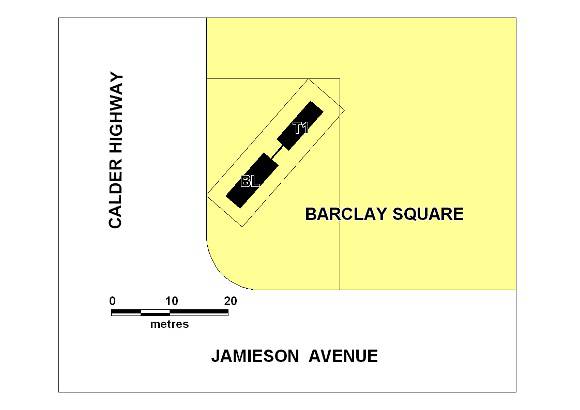
LocationNORTH EAST CORNER OF CALDER HIGHWAY AND JAMIESON AVENUE RED CLIFFS, MILDURA RURAL CITY
File NumberHER99000093LevelRegistered |
|




Statement of Significance
What is significant?
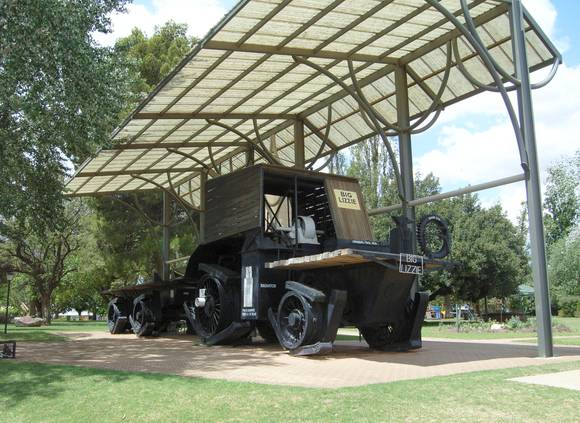
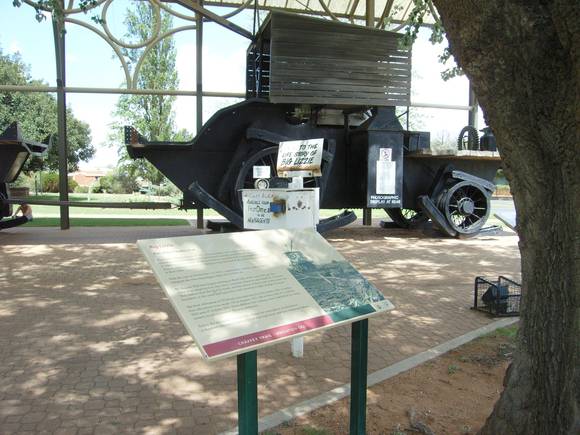
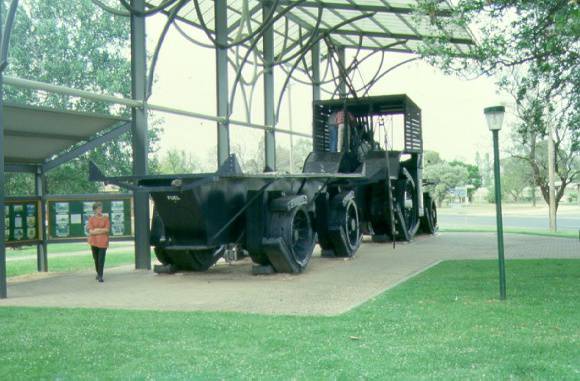
Big Lizzie is a road train comprising the tractor (Big Lizzie) and one of two original trailers. The tractor and trailers were constructed with dreadnaught wheels designed to a 1906 patent by Frank Bottrill. Bottrill had worked in Broken Hill as a blacksmith in the late 1890s and gained experience with steam engines there. Around the turn of the century aqttempted to transport wool from stations north of the Murray with a steam traction engine. The failure of this venture, when he had to abandon the engine in deep sand, stimulated him to invent the Dreadnaught wheel, which he patented in 1906. The wheels were developed and proven on a variety of traction engines and road trains in the years before Bottrill commenced work on Big Lizzie. Bottrill planned to use this vehicle for transport of goods between the Murray and outback N.S.W. Construction began in a yard in Richmond in 1915 with close cooperation from the nearby McDonalds Foundry, which made the massive gearing and bearing components.
Big Lizzie terminated its inaugural journey to Broken Hill prematurely at the flooded Murray River in Mildura in October 1917. Big Lizzie was first used to carry a record-breaking load of 80 tons of wheat, and undertook other hauling tasks in the area. Big Lizzie had a number of failings, including a maximum speed of one mile per hour, a huge turning circle and inadequate steering gear. Despite these problems, Big Lizzie was found to be very effective for the land clearing which was going on apace in the Mallee in the 1910s and 1920s. In 1920 the Victorian Government, through the State Rivers and Water Supply Commission, contracted Bottrill to carry out a large scale clearing operation at Red Cliffs to create irrigation blocks for soldier settlement. Clearing in the area was previously largely carried out with small grubbing machines. Big Lizzie was equipped with a number of steel cables for pulling out trees and stumps, and a gang of up to sixteen men worked in a supporting role on the ground.
In 1926, when the work was completed, Bottrill took Big Lizzie to Glendinning to use on a clearing and share-farming operation there. This enterprise soon failed and Big Lizzie was left on the station until reclaimed by the Big Lizzie Restoration and Preservation Committee for the Red Cliffs community in 1971.
How is it significant?
Big Lizzie is of historical and technological significance to the State of Victoria.
Why is it significant?
Big Lizzie is of historical significance for its association with land clearing for agriculture in the Mallee and Mildura region. This phase of clearing in the Mallee coincided with the setting up of soldier settlement schemes following World War One, and with the continuing ideal of closer settlement. There were a number of grazing leases in the Mildura area which could be readily resumed by the government, and irrigation blocks were a favoured means of settling a large number of families on limited supplies of land. The clearing at Red Cliffs in which Big Lizzie was involved is a major example of this development. Big Lizzie is also of historical significance as an attempt to reduce transport costs that were still a burden to primary producers in the inland areas distant from railheads.
Big Lizzie is of technological significance as the only conserved example of the innovative Dreadnaught wheel developed by Frank Bottrill and applied to tractors for land clearing and hauling under difficult outback conditions. While the caterpillar track would ultimately prove the most successful design for the purpose, the dreadnaught wheel proved reliable and effective for its purpose and was widely, if briefly used in Victoria, Queensland and South Australia. The Dreadnaught wheel demonstrates the part played by the individual inventor, experienced in outback conditions, in the development of technology for Australian bush. Though less lasting in its impact, the Dreadnaught wheel was an invention in the same lineage as the stump jump plough and the McKay's harvester.
Big Lizzie is of technological significance as a prime mover for its unusual design and for its sheer size, mass and hauling capacity. Big Lizzie was a one-off design which made use of a hybrid collection of available technologies, designs and materials.
Group
Farming and Grazing
Category
Farm Objects (movable)