
| Back to search results » | Back to search page » |


|
UNITING CHURCH
Other NameST ANDREW'S PRESBYTERIAN CHURCH Location3229 PORTLAND-CASTERTON ROAD, DIGBY, GLENELG SHIRE LevelRecommended for Heritage Overlay |
|


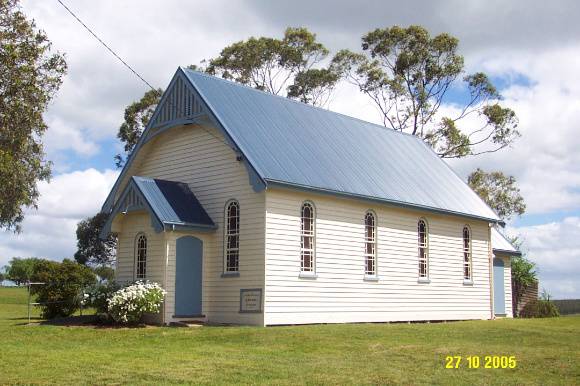


Statement of Significance
What is Significant?
St. Andrew's Uniting Church, Digby was built in 1908 as a Presbyterian Church and is located on the highest point in the town. It seems unlikely that there was an earlier building. It is a simple but fine building in a hybrid of the Carpenter Romanesque and Queen Anne Revival styles, perhaps reflecting a decline in the fashion for the Gothic Revival taste. The church is built of timber, now painted white with blue details. The church has a rectangular nave with a small entrance porch and an off-centered vestry. The semi-circular arched windows have glazing subdivided into central panes of clear glass and borders of 'Murano' pressed glass in different colours. The marble foundation stone was 'laid' by William McKay Shaw, the owner of Rifle Downs, one of the most important pastoral properties in the district. The builder was Charles Kohn of Merino. The building is in very good condition and retains an excellent degree of integrity.
How is it Significant?
The Uniting Church is of historical, social and architectural significance to the Glenelg Shire.
Why is it Significant?
St. Andrew's Uniting Church, Digby is of historical significance as an example of the consolidation of Presbyterian faith in the Digby area from the 1900s, notwithstanding the steady decline of the town from the 1870s. The church is of social significance to the community of Digby and as the focus for Presbyterians who settled in the area from the 1900s. It is of further social significance for its association with the owners of Rifle Downs, William McKay Shaw and Elsie McKenzie Shaw. It is of architectural significance for its use of a non-Gothic style, reflecting a change in taste by the Presbyterian Church.
Group
Religion
Category
Church