
| Back to search results » | Back to search page » |


|
RIFLE DOWNS
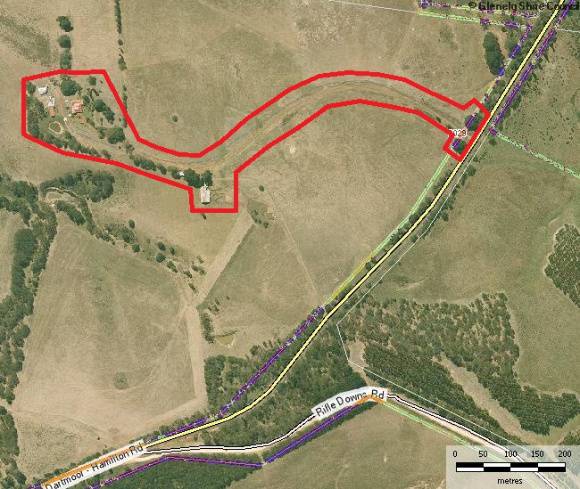
Other NameRIFLE DOWNS HOMESTEAD Location2029 DARTMOOR-HAMILTON ROAD, DIGBY, GLENELG SHIRE LevelRecommended for Heritage Overlay |
|




Statement of Significance
What is Significant?
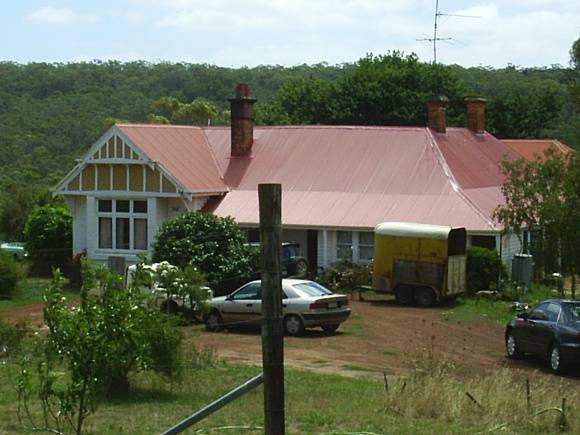
Rifle Downs Homestead overlooks the Stokes River and is located at 2029 Dartmoor-Digby Road, Digby approximately 7.5km south-west of Digby and 19.0km north-west of Dartmoor. Rifle Downs Station was taken up at first in 1847 by James Crawford, Scottish sheep farmer, and, after Crawford's death in 1848, was transferred in c1849 to Richard Lewis, publican and farmer. He owned the early 1840s Wool Pack Inn at Emu Creek (Digby) from 1842 to 1854, and was associated with a number of early pastoral properties during the 1840s and 1850s. The brick homestead with a verandah on three sides was constructed (or perhaps completed) for Lewis. His improvements to the property including the homestead, out offices, woolshed and stables, were valued at 1800 pounds in 1853 and at 5000 pounds in 1855. Although a simple colonial bungalow of six rooms, its aesthetic siting, practical planning, careful detailing and overall quality strongly suggest that it was designed by an architect. The Tasmanian architect, Samuel Jackson with his brother William, owned the nearby Sandford Station. Some materials must have been imported, probably through Van Diemen's Land including at least one Regency style marble mantelpiece, extensive cedar joinery and possibly much of the pit-sawn hardwood. Other materials, such as the bricks, must have been produced on the property. Lewis owned important horses, both as racehorses and stud draught horses, and he maintained a racecourse on Rifle Downs which would have complimented his role as a publican. He lost the property to his mortgagors and, in 1878, Captain John Philip took up the lease, establishing his son James Robertson Philip as manager who took over Rifle Downs in his own right in 1881. James and Margaret Philip abandoned Rifle Downs in 1891 as unviable because of fluke in the sheep and the deepening economic depression of the time. In 1893 the property was taken over by William McKay Shaw, of the McKay Sunshine Harvester family. He married Elsie Agnes McKenzie in 1907 and this triggered major alterations and additions, including the new dining room and rear wing. Other changes were made in the 1960s. The family still occupies the house which retains a high degree of integrity to its early twentieth century period and it is in good condition. The garden includes several significant trees and two Quercus robur, English Oaks still mark the beginning of the drive.
How is it Significant?
Rifle Downs Homestead is of historical and architectural significance to the State of Victoria and the Glenelg Shire.
Why is it Significant?
Rifle Downs Homestead is of historical significance for its association with James Crawford, Richard Lewis, James Robertson Philip and his family and subsequently the Shaw family. The homestead is of architectural significance as one of the best surviving examples of pre-1851 domestic architecture in a rural setting, especially notable for its internal late Georgian detailing and use of cavity brick construction, and for its subsequent alterations in 1907.
Group
Residential buildings (private)
Category
Homestead building