
| Back to search results » | Back to search page » |


|
CASTLEMAINE PUBLIC CEMETERY (CAMPBELL'S CREEK)
LocationCEMETERY ROAD CASTLEMAINE, MOUNT ALEXANDER SHIRE
File Number607961LevelRegistered |
|


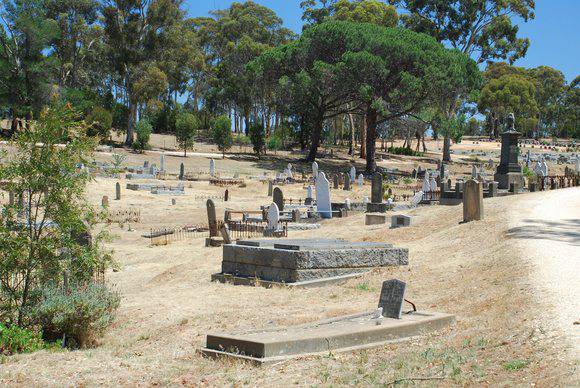


Statement of Significance
What is significant? The Harcourt granite War Memorial erected in 1932 by the DADS
Association, Castlemaine, is of significance to the community and
commemorates servicemen who fought in the war.
The first Castlemaine cemetery occupied a
small area in the fledgling township that was soon straddled by
Templeton Street. After a great deal of controversy a site for a new
cemetery was chosen outside the municipal boundary, at Campbell's
Creek. The first interment at this site was in 1852, with the original
four acres being enclosed the following year. Amid further
controversy, in December 1856 the bodies from the old cemetery were
exhumed and re-interred at Campbell's Creek. In April 1858 the
cemetery was placed under the care of trustees, and this move
initiated improvements; between this date and October 1859 a layout
plan was adopted (July 1859). A sexton's office was built, a
carriageway was constructed, and each religious denomination was
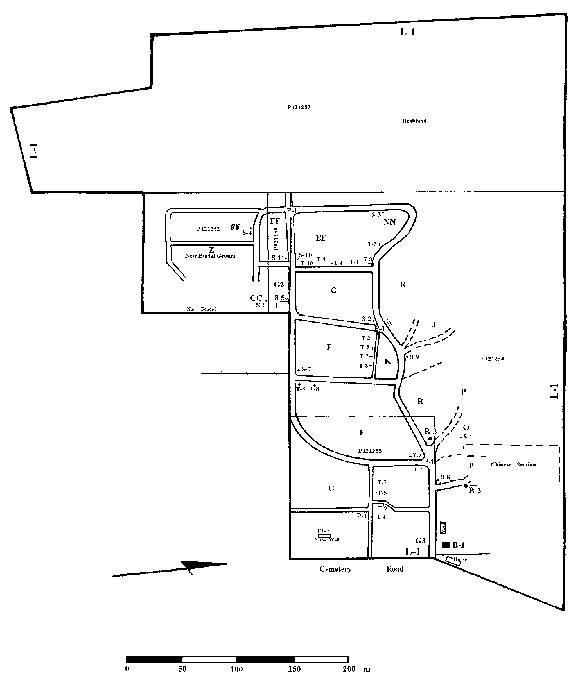
allotted its section, with the Chinese compartment being enclosed by a
rail fence. About 107 footstones survive in the Chinese section. By
1859 the Chinese community had also erected a building for performing
their burial rites, and the burning tower which survives in the
Chinese section may indeed be this structure. Some of these design
elements are detailed on a large plan of the cemetery dated December
1875 drawn by M Brown, District Mining Surveyor and Registrar of
Castlemaine remains in the office. Throughout the twentieth century
many older elements within the cemetery were renewed; old wooden water
channels and bridges were replaced by concrete, senescent trees were
replanted, the front wooden fence replaced by pipe and wire (1957).
The old sexton's residence replaced and a lawn cemetery was introduced
in 1961 resulting in the transferral of many cemetery monuments.
How is it significant?
The Castlemaine Cemetery is of
historical, social, architectural, and aesthetic significance to Victoria.
Why is it significant?
The Castlemaine Cemetery is historically
and socially important for its direct association with one of
Australia's significant episodes of immigration. Within a decade
Victorian gold had drawn 600,000 immigrants, tripling the entire
population of Australia, with the Mount Alexander diggings at
Castlemaine being one of the largest and richest goldfields in the
colonies. This influx is demonstrated by the large numbers of burials
and memorials dating from the 1850s and 60s, which provide information
on many immigrants, including the Chinese alluvial miners who arrived
in large numbers during this period. The development of the
Castlemaine Cemetery and the construction of the sexton's office in
the late 1850s provide physical evidence of the permanent public
facilities and structures which replaced the ephemeral arrangements of
early goldfield days. The c1875 layout of the cemetery is historically
important for its rarity and for the information it yields about
nineteenth century cemetery design. The graves are important for the
information they provide about burial customs and patterns.
The Castlemaine Cemetery is architecturally important for its rare
structures, being the sexton's office, and Chinese funerary tower,
both of which are rare in the stock of nineteenth century structures
that survive in Victoria's cemeteries. The office has further
importance for exhibiting the principal characteristics of a typical
mid-nineteenth century sexton's building, and is the oldest and best
surviving example in this State of a cemetery building of this type.
The cemetery memorials, tombstones, all of the Chinese footstones and
other funerary art are collectively important for their design
characteristics and craftsmanship. Also of note are the cast iron and
metal alloy denomination and section markers.
The Castlemaine Cemetery is aesthetically important as an early
example in Victoria of a cemetery influenced by Romantic and
Picturesque ideals which gained worldwide popularity in the early to
mid-nineteenth century. This is demonstrated in the layout, which
picturesquely rises through the clefts in the surrounding hills, and
in the pattern book-style Picturesque sexton's office. Other notable
features contributing to the layout are bulbs and several tree species
which include Cupressus sempervirens x3, Chamaecyparis
funebris x 2, Pinus pinea x 2, a Sequoiadendron
giganteum, Cupressus lusitanica var. benthamii x 2,
and rare Arbutus x andrachnoides x2.
Group
Cemeteries and Burial Sites
Category
Cemetery/Graveyard/Burial Ground