
| Back to search results » | Back to search page » |


|
TRAM SHELTER
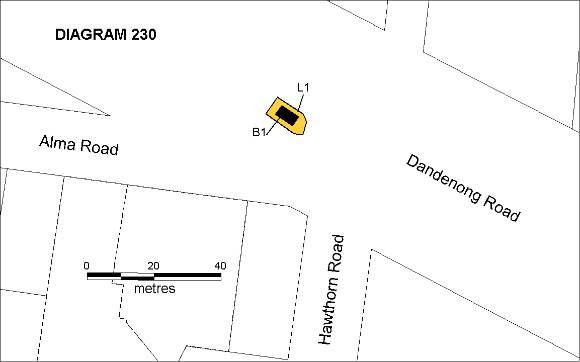
LocationCORNER DANDENONG AND ALMA ROAD CAULFIELD NORTH, GLEN EIRA CITY
File Number605771LevelRegistered |
|





Statement of Significance
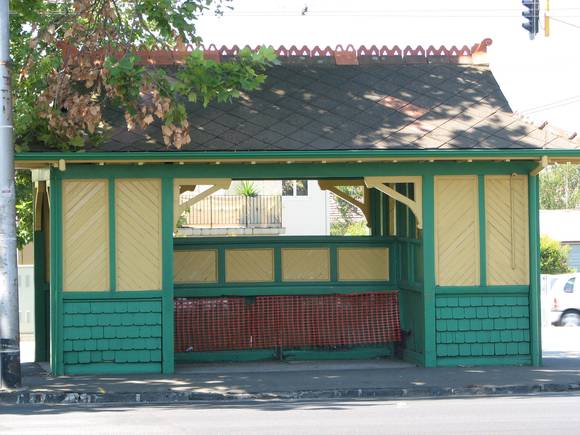
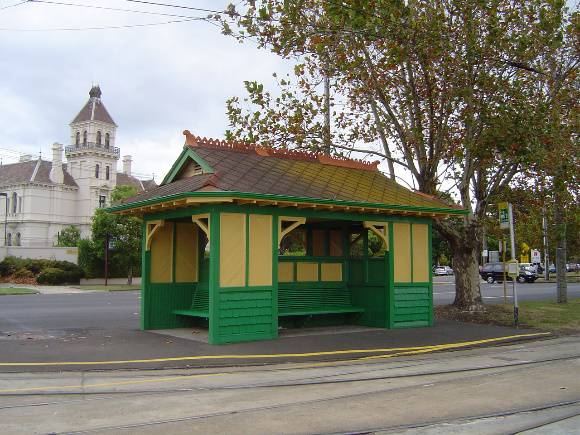
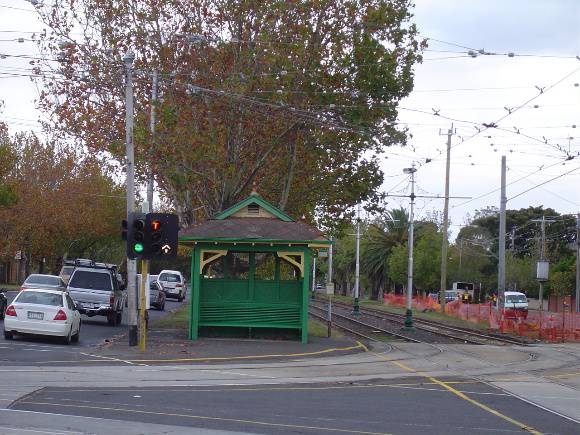
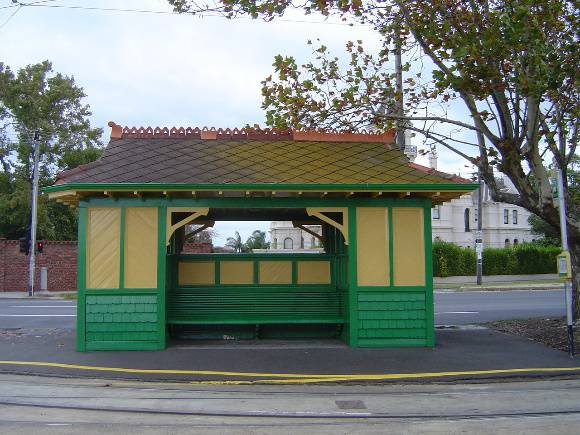
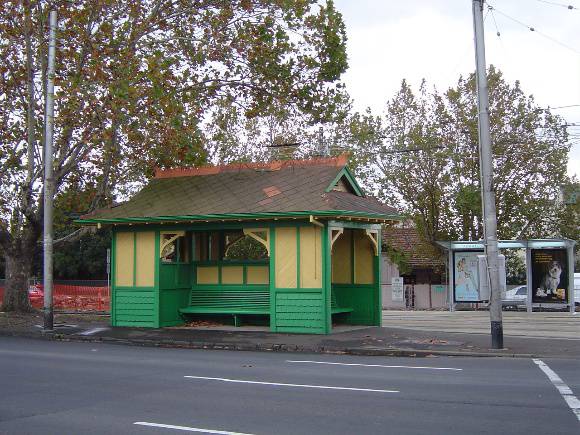
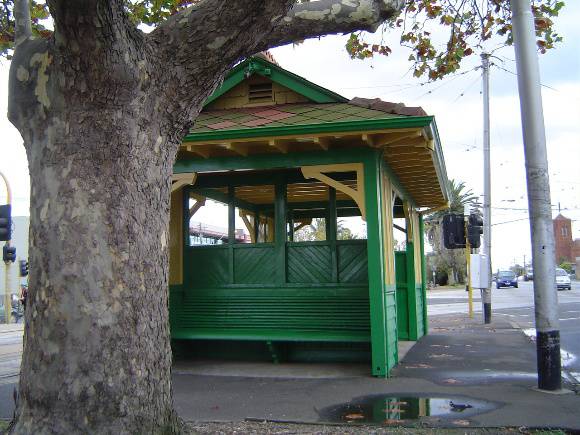
What is significant? The waiting shelter at Dandenong Road, Caulfield was built in 1912 to a design by Leonard J. Flannagan, chief architect for the Prahran & Malvern Tramways Trust. The shelter is constructed mainly of timber and has a half hipped roof with deep overhanging eaves. The small 'gablet' at each end has plain barge boards, the gable is faced with shingles and contains a louvred vent. The roof is clad in red asbestos tiles with a crested terracotta ridge terminated by scrolled terracotta finials. The hips have plain terracotta ridge tiles. The rafters are exposed under the projecting eaves, and the underside lined with boards. The walls are timber-framed with the upper panels (above dado) lined with V jointed boards arranged diagonally. The lower panels (below dado) are clad with vertical V jointed lining boards on the internal face and shingles on the external face. The interior is sub-divided by timber partitions into four alcoves framed by simple timber brackets; each has a built-in bench seat made of timber slats. The seats face in all four directions. The waiting shelter is located at the corner of Dandenong Road and Hawthorn Road, at an interchange point in the tram network. The line from Wattletree Road, Malvern along Glenferrie and Dandenong Roads to the railway station at Windsor was opened on 16th December 1911. This route was extended to Chapel Street in February 1912 and linked to the cable tramway. On 12th April, 1913 the Balaclava Road extension was opened, from Dandenong Road, Malvern to St. Kilda Beach, via Hawthorn and Balaclava Roads and Carlisle Street. How is it significant? The waiting shelter at Dandenong Road, Caulfield is of historical and architectural significance to the State of Victoria. Why is it significant? The shelter at the junction of Dandenong Road and Hawthorn Road is of historical significance for its association with the development of the suburban (electric) tram network which assisted the expansion of Melbourne as a suburban metropolis. It is also of historical significance for its connection with the Prahran & Malvern Tramways Trust (1907-1920). The Prahran & Malvern Tramways Trust was the first municipal electric tramway in Melbourne, becoming the largest and most successful of all the municipal tramway trusts. Its services played a key role in facilitating suburban expansion and the development of the southern and eastern suburbs. The growth of tramways was one of the greatest municipal developments in Victoria during the first decade of this century. The waiting shelter is an important remnant of this period of Melbourne's transport history and a tangible reminder of the Prahran & Malvern Tramways Trust. The waiting shelter at Dandenong Road is of architectural significance as the only remaining shelter of this type from the Prahran & Malvern tram network. The waiting shelter was designed by notable Melbourne architect Leonard J. Flannagan who designed a number of buildings for the Prahran and Malvern Trust including the early sections of the depot at Malvern, and also a depot for the Hawthorn Tramways Trust. The shelter, which dates from 1912, is an early example of an open rest house. The building, which is in the form of a pavilion, is largely in keeping with the original design and retains its integrity. The tram shelter is also of architectural significance as an important example of early twentieth century street architecture.
Group
Transport - Tramways
Category
Tramway Station/Waiting shed