
| Back to search results » | Back to search page » |


|
ELLERSLIE BRIDGE
LocationOVER HOPKINS RIVER, HOPKINS HIGHWAY ELLERSLIE, MOYNE SHIRE
File Number605764 (1) [closed]LevelRegistered |
|




Statement of Significance
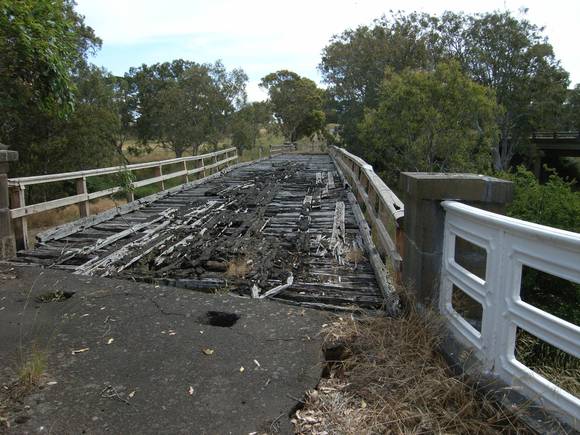
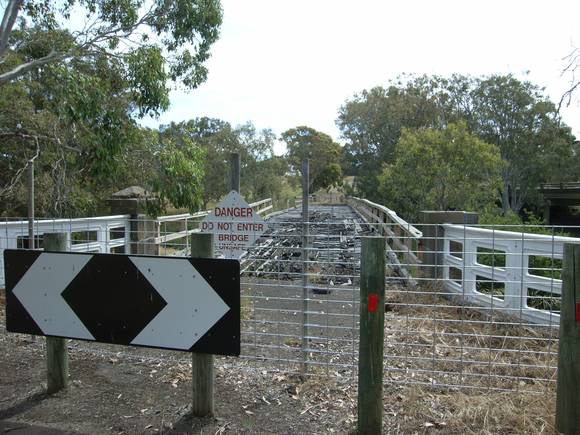
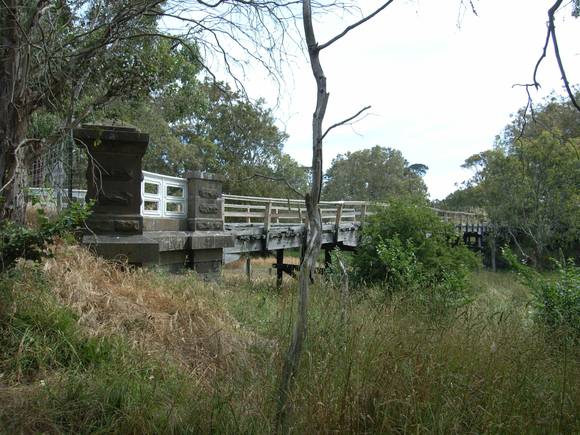
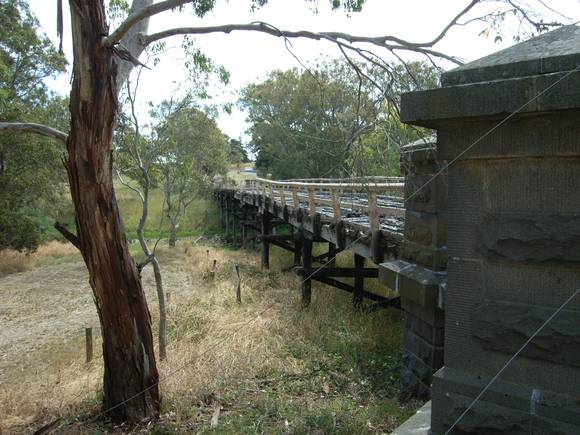
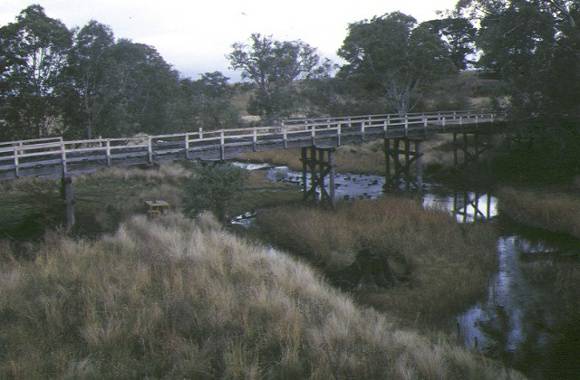
What is Significant? The Ellerslie Bridge is a large disused timber and masonry bridge over the Hopkins River beside the Hopkins Highway at Ellerslie. It was built in 1867 at the crossing place then known as Letts Ford. It was designed by noted architect, Andrew Kerr, and constructed under the supervision of carpenter-mason, J A Stone. Although it underwent major renovation around 1900, much of the original carpentry detail appears to have been faithfully reproduced. It has eight timber spans with squared beams secured by iron straps; rare tapered corbels; round-ended walers and crossheads; and unique moulded handrails. In addition to the masonry, some timber members of the substructure may be original. Remarkably, the whole structure is square and without major sags or intrusive additions such as mid-span props or steel relieving beams. Apart from the deck and side railings, is in reasonably sound condition. It is attractively set at the end of a former Avenue of Honour of cypress trees, and amongst mature eucalypts. It is an informal picnic site for travellers. How is it Significant? Ellerslie Bridge is of historical, scientific (technical), and aesthetic significance to Victoria. Why is it Significant? It is of historical significance for its early age, being Victoria's second oldest positively dated timber-beam road bridge, and one of only two surviving timber bridges known to have resisted Victoria's epic floods of 1870. It expresses the development and consolidation of the Western District road network in the post gold-rush era, and in particular, the importance of the connection between pastoral properties and the port of Warrnambool. It is the largest of a number of composite masonry and timber bridges built in the district, and at its opening was described as the 'handsomest in Western Victoria'. Its association with the remnants of the original timber and stone ford, and a 1967 reinforced concrete bridge, constitutes a complete historical record of a European-era crossing place. It is the end-point of Ellerslie's Avenue of Honour. It is of scientific (technical) significance as the largest and most original example of an important class of colonial-era composite timber beam and masonry bridges. Its bluestone abutments and curved wing walls are among the finest and most intact examples of masonry in this type of bridge, providing important evidence of colonial bridge building techniques and craftsmanship. The cast-iron insert panels, and thrust blocks to support the original timber struts, are rare features. Built on a slight skew alignment, with a mixture of foundation types, it incorporates the best surviving example of timber trestle piers over rare stone sub-piers. Its timber components incorporate more rare or unique features of 19th century bridge carpentry than any other bridge in Victoria and are remarkable for their fine craftsmanship and general condition. The bridge is exceptionally intact for a timber bridge if its age, in terms of overall design, the unmodified form of basic timber elements, and surviving original or early detailing. It is one of the largest surviving timber beam road bridges in Victoria, being of exceptional overall length, height and number of spans. It is also of exceptional maximum span length, with its 9.8 metre span being the longest known span length amongst surviving examples of unrelieved square timber beams in the typical nineteenth century style. It is of aesthetic significance as an unusual example of an architect-designed timber bridge, and for such notable features such as the ornamental cast-iron parapet panels. Its bluestone abutments, wing walls and piers are elegant and finely finished. It also contains fine timber features, some of which appear to be unique, such as its tapered corbels, moulded softwood hand-railings, and the rounded ends of the cross-braces and walers. Its attractive setting comprises the remnant natural eucalypt vegetation along the river bank, and the substantial row of cypresses along its disused approaches, originally planted as an Avenue of Honour. It is highly visible and well appreciated from the new highway bridge adjacent.
Group
Transport - Road
Category
Road Bridge