
| Back to search results » | Back to search page » |


|
ALL SAINTS CHURCH, HALL AND FORMER VICARAGE
Location2 CHAPEL STREET ST KILDA EAST, PORT PHILLIP CITY
File Number606798LevelRegistered |
|




Statement of Significance
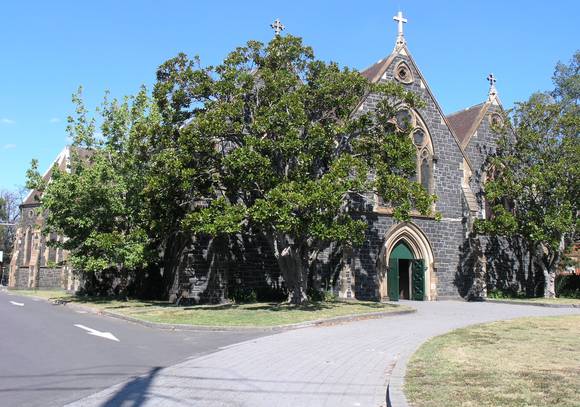
STATEMENT OF CULTURAL HERITAGE SIGNIFICANCE: Work on All Saints' Church which is constructed of bluestone with
freestone dressing, commenced in 1858 to the Early English design of
Nathaniel Billing, the English-born architect and articled student to
the famous Gothic revivalist, George Gilbert Scott. The nave and
triple-gabled Chapel Street facade were erected during this period, as
well as a polychromed vicarage presumably also designed by Billings.
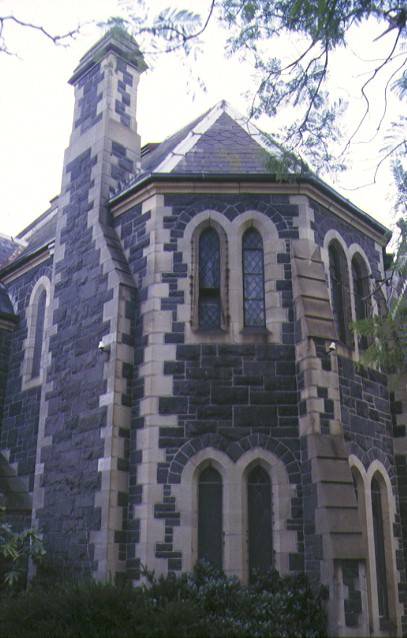
In 1873 the church was extended by architect Frederick Wyatt. The
design departed from Billings' model by the inclusion of an apsidal
sanctuary and chancel. In 1882, some time after Wyatt's death the
chancel aisles and vestry were added under the supervision of
architects Terry and Oakden. Since then many ornate fixtures and
fittings have been added to the church, notably the High Victorian
style decoration in the sanctuary and chancel, the baptismal font, the
war shrine, the rare west window, and the richly decorated Gothic
blackwood screen of 1918 designed by architect Louis Williams. Work on
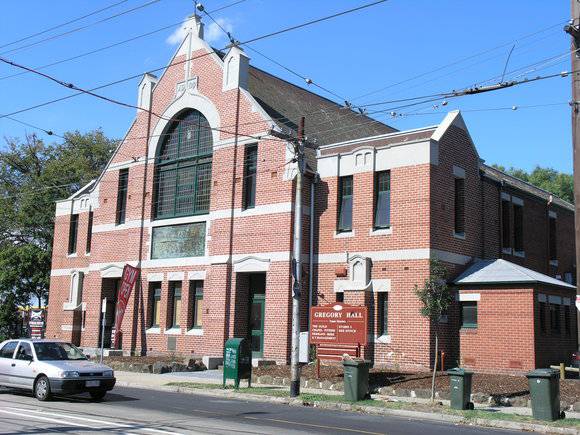
the Gregory Memorial Hall commenced in 1908 to the design of
architect, P. G. Fick. Constructed of red brick, the abstracted Gothic
hall is influenced by the Arts and Crafts movement and was named after
the founder of All Saint's Church, John Herbert Gregory (1827-1897). All Saints' Church, former Vicarage, and Hall are of architectural,
historic and aesthetic importance to the State of Victoria. All Saints' Church, former Vicarage and Hall are architecturally
important as an example of the complimentary work of several
architects, notably Nathaniel Billing whose original model of the
church remains in the north transept, Frederick Wyatt, Terry Oakden,
and Louis Williams, all renowned for their ecclesiastical designs. The
church model is significant for its rarity. The church is an
outstanding example of the evolutionary use of the Gothic Revival, the
progenitor and the predominant style of all religious architecture in
Australia, and its unusual plan and form incorporates French
influences. The church is aesthetically significant for the quality of
its interior decoration, and objects, notably the stencilled designs
of the chancel, the pair of candelabra, which were obtained from King
George II's chapel, Windsor, the chapel and sanctuary screens of
wrought iron, the elaborately carved narthex screen and stone
monuments, the fixed cedar pews dating from the 1860s, as well as the
many fine stained glass windows designed by Ferguson & Urie, and
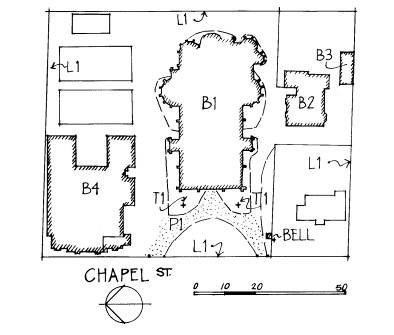
Clayton & Bell of London. The All Saints' Church forecourt is
historically and aesthetically important for its symmetrical design
which compliments the formal qualities of the triple-gabled building.
Landscaping features include the curved paving and the two Magnolia
grandiflora trees which flank the central doorway of the church. The former Vicarage is of architectural and historic importance as
one of the first examples of the use of polychrome brickwork, which
became popular in the later nineteenth century. It is also significant
as a model example of what was considered to be the ideal English
vicarage. The Gothic detailing of the interior is a notable decorative feature. Gregory Hall is important for its abstracted Gothic Arts and Crafts
design which compliments the architectural forms within the All
Saints' precinct, and for its interior which survives largely intact
with its hammerbeam roof, gallery, and copper detailing. All Saints' Church, former Vicarage and Hall are together important
for their associations with Rev JH Gregory, founder of All Saints'
Parish and Church. Pioneer bush Minister, and the first Anglican
Minister to the Victorian goldfields, Gregory was Vicar of All Saints'
from 1858 to 1893. As a Jubilee Thanksgiving, All Saints' Parish
erected the Gregory Memorial Hall in their founder's honour. The
collection of surviving buildings illustrates the wide range of
cultural activities centred on this important parish complex
Group
Religion
Category
Church