
| Back to search results » | Back to search page » |


|
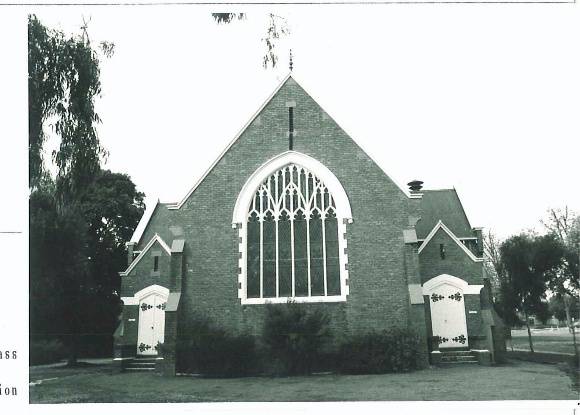
Uniting (Former Wesleyan Methodist) Church
Location109 Lonsdale Street HAMILTON, Southern Grampians Shire
File NumberHAMDS #077LevelStage 2 study complete |
|




Statement of Significance
SIGNIFICANCE: »As the focus for the Wesleyan Methodist denomination and now the Uniting Church in Hamilton and as an example of the work of the Ballarat firm of architects, Clegg, Miller & Cain. Washingtonia robusta palms on the Significant Trees Register. STATEMENT OF SIGNIFICANCE Uniting, former Wesleyan Methodist, Church The church, with its associated halls and parsonage, is of local significance historically as the focus for the Wesleyan Methodist denomination and now the Uniting Church in Hamilton. It is also significant architecturally as an example of the work of the Ballarat firm of architects, Clegg, Miller and Cain. ([i]) It was built in 1913 and was the second Methodist church in Hamilton, the first being on Church Hill in McIntyre Street. Methodism was a strong and formative influence in Hamilton from the earliest times. ([ii]) Its members were leaders of the Temperance Movement which was particularly strong in Hamilton. The simple Gothic revival style of the church is rather old fashioned compared with metropolitan examples at this time but it reflects the conservative nature of the congregation and, paradoxically, shows how far the Wesleyans had changed from their origins when they eschewed anything Gothic in style.. The use of red brick is typical for the period and the architects. The church is a critical landmark at the apex of the junction of Lonsdale Street with Alexandra Parade which is emphasised by the planting of a row of Washingtonia palms in the latter. The building is significantly intact and in good condition. [i] Foundation stone and Lewis, M, Australian Architectural Index. [ii] HSA DP 950, 951, 1953 (1938), Garden, D, Hamilton, passim.
Lonsdale Street and Alexandra Parade
Group
Religion
Category
Church