
| Back to search results » | Back to search page » |


|
West Hawthorn Precinct
LocationWest Hawthorn Precinct LevelIncluded in Heritage Overlay |
|




Statement of Significance
Precinct character and significance
The West Hawthorn Precinct was identified by the 'Hawthorn Heritage
Study' (M Gould, 1993). A half-page precinct citation is found in
section 4.2.6 (pages 84-85) of Volume 1 of that report, which is
reproduced here:
West Hawthorn Precinct.
Representative of the Growth of Hawthorn as a Victorian Garden
Suburb 1856-1900, particularly Workers Cottages and Associated
Industrial areas.
Brick making has been the single major industrial activity for the
Municipality throughout its development. Several pits with
associated workers housing occurred throughout the Municipality. The
best example of this theme of development in Hawthorn is at West
Hawthorn, centred around previous clay pits at Smart Street Reserve,
Mason Street Reserve and Fashoda Street Reserve. In line with the
high status of Hawthorn, the housing here remains better than for
similar Industrial developments on the opposite riverbank and points
to another socio economic level of the garden suburb ideal, seeking
refuge from the low urban amenity of the unsewered workers
accommodation in the inner city.
West Hawthorn is locally significant as an illustration of: the
influence of the brick industry; of workers housing; and of the
garden suburb ideal for the less affluent.
A revised statement of significance was prepared for the West
Hawthorn Precinct (HO220) as part of the 'Review of Heritage Overlay
Precinct Citations' (Lovell Chen, 2006). It reads as follows:
The West Hawthorn Precinct, Hawthorn, is an area of heritage
significance for the following reasons:
- The place is a large and varied concentration of brick and timber
Victorian worker's cottages and modest residences. Connell and Mason
Streets have a good proportion of brick residences, while College,
Fashoda, Spencer Streets have a higher concentration of timber
workers' cottages.
- The place is representative of the growth of Hawthorn as a
Victorian garden suburb from 1856-1900, particularly the use of the
garden suburb ideal through the incorporation of parkland in order
to improve the amenity of workers housing.
- The precinct also includes a mix of late Federation and interwar
houses and flats.
This is reflected in the current extent and valued buildings within
the precinct, which are predominately modest Victorian-era houses of
brick and timber, some of which are quite early (1850s or '60s), with
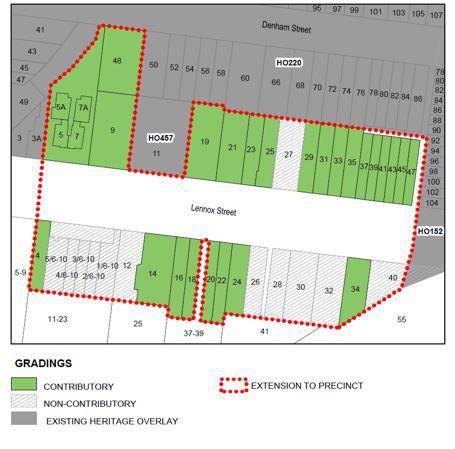
Edwardian and interwar houses and flats scattered among them. The current boundary of HO220 West Hawthorn Precinct is adjacent to
the proposed precinct extension with interwar flats at 3-3A Lennox
Street adjoining the proposed extension, as well as Victorian and
Edwardian houses at 50-86 Denham Street. To the east the extension borders on HO152 Grace Park & Hawthorn
Grove Precincts at 78-104 Elgin Street. The main focus of this
precinct is the Federation-era development in the curvilinear Grace
Park subdivision, and the Victorian-era development to its north
(Hawthorn Grove). It is not clear from the precinct description in
'Hawthorn Heritage Study' (M Gould, 1993) or the 2006 statement of
significance why it has been extended to the west of Power Street as
far as Elgin Street (bordering HO220 West Hawthorn Precinct).
Extension character
The buildings in the proposed extension along Lennox Street, west of
Elgin Street, comprise a mix of housing types - from timber cottages
and brick houses, to terrace rows and flats - and built dates among
the Contributory properties ranging from the 1850s to the outbreak of
World War II. The Victorian-era dwellings in the extension include two early timber
cottages at Nos. 14 and 24. It was built in the mid-1850s for Major
Charles Newman, making it the oldest surviving house in the original
Hawthorn village block. The two dormer windows at the front of the
hipped roof were added in the 1980s (Pers. Comm., Hawthorn Historical
Society, 2017). There are also two pairs of semi-detached brick houses at Nos. 16-22
that have a shared hipped roof, not divided by a central party wall,
indicating a pre-1885 date. There are other brick and timber Victorian
houses at Nos. 4, 19, 21, 28 & 34, and a late-1880s single-storey
terrace at Nos. 37-47 (the work of the same builder as the two-storey
terrace around the corner at 78-104 Elgin Street in HO152). 'Ventnor'
at No. 34 was built in 1883 as the home of Charles Baker, who was a
councillor and mayor of Hawthorn in 1872-73. He had a shop in Burwood
Road to the rear of his home (Pers. Comm., Hawthorn Historical
Society, 2017). The intactness of the Victorian dwellings is good to
fair, with many alterations to verandah detail and a few to windows.
This level of intactness is superior to much of what is seen among
nineteenth-century houses in the current extent of HO220, for example
those to the north on Denham Street. There is a lesser amount of Edwardian development, along the north
side of Lennox Street. These include a large brick villa at No. 9 and
two semi-detached pairs at Nos. 29-35. The semi-detached dwellings are
particularly attractive, with paired half-timbered gables and large
round-arched front windows. The pair at Nos. 29-31 are identical in
design to 70-76 Denham Street at the rear, and the whole group was
clearly built as a single development. The Denham Street pairs are
Contributory to HO220 West Hawthorn Precinct. Interwar dwellings on Lennox Street are the smallest in number, most
of which are already in the Heritage Overlay. The late 1930s brick
two-storey maisonettes at 3-3A Lennox Street are Contributory in
HO220, and Lennox Court flats at 11 Lennox Street, built in 1939-40,
have an individual HO (HO457). The only interwar dwellings not yet in the Heritage Overlay are the
group of four single-storey flats at 5-7A Lennox Street, built of dark
brown manganese bricks and massed to look like a semi-detached pair
(the last two flats are hidden at the rear). On Denham Street there is a single property currently left outside
the HO220 precinct boundaries: Denham Court Flats at 48 Denham Street.
This L-shaped block of red-brick flats were listed in the 1942 Sands
& McDougall's Street Directory, so are interwar in date.
Conclusion
In the proposed Lennox Street part of the extension, there are 26
dwellings fronting the street that would be Contributory to HO220 West
Hawthorn Precinct plus one that would be Significant (11 Lennox
Street, HO457), and 11 that would be Non-contributory. This is an
overall 71 percent of properties that are Contributory or Significant.
As noted above, their intactness is comparable or better than those
seen in the existing HO220 Hawthorn West Precinct. The proposed Contributory (and Significant) buildings correspond with
the categories set out in the HO220 statement of significance: 'brick
and timber Victorian worker's cottages and modest residences' and 'a
mix of late Federation and interwar houses and flats'. The early
houses at 14 and 24 Lennox Street are of particular interest. A full list of the individual gradings can be found in the PDF
citation attached, or the child records.
Group
Urban Area
Category
Boundary Feature