
| Back to search results » | Back to search page » |


|
Angle Road Precinct
Location1-13 Angle Road DEEPDENE, BOROONDARA CITY LevelIncluded in Heritage Overlay |
|




Statement of Significance
What is Significant?
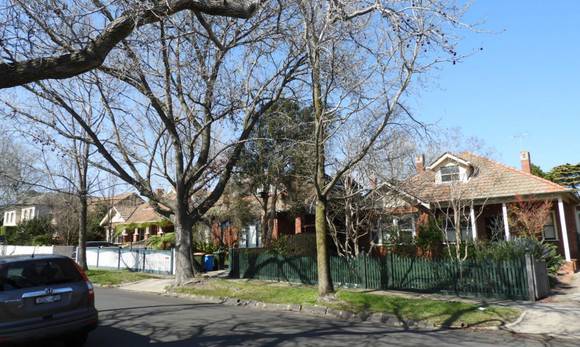
The Angle Road Precinct, comprising 1-13 and 2-12 Angle Road,
Deepdene, is significant. The following features contribute to the significance of the precinct: - The houses constructed from 1922-1925, as shown on the precinct map. - The overall consistency of housing form (gabled hip or intersecting
transverse and gable-fronted roofs, asymmetrical bungalow forms),
materials and detailing (face brick or roughcast and brick external
cladding, terracotta tiled roofs, brick chimneys), and siting
(consistent front setbacks). - Streetscape materials such as bluestone kerbs and channels. Contributory buildings include 1, 2, 3, 4, 5, 6, 8, 9, 10, 11, and 13
Angle Road. Features that do not contribute to the significance of this place
include non-original alterations and additions to the contributory
buildings and the non-contributory dwellings at 7 and 12 Angle Road.
How is it significant?
The Angle Road precinct is of local historic, architectural
(representative) and aesthetic significance to the City of Boroondara.
Why is it significant?
The Angle Road Precinct is historically significant as it
demonstrates the former location and subdivision pattern of Glencoe
Estate and St Ronans Estate, established in 1885 and 1887
respectively, but not built on until the 1920s because of the economic
depression of the 1890s. The construction of the subject residences in
a relatively short period of five years, between c1920 and 1925,
evidences the increased demand for housing in the area facilitated by
the establishment of improved transport, sewerage and electricity
services to Balwyn. The precinct also clearly demonstrates the
importance of local builders/developers, such as George Simpson, to
whom the subject buildings are attributed, who rapidly built up entire
unified streetscapes. (Criterion A) Houses in the Angle Road Precinct are representative of styles
popular during the 1920s, including examples of California Bungalows,
all of which exhibit a high level of intactness. They demonstrate the
principal characteristics of early interwar bungalows constructed in
brick, illustrating the transition from Edwardian to typical interwar
bungalow forms. Most of the houses have characteristic massing with an
asymmetrical, bungalow form set beneath one of two dominant roof types
clad with terracotta tiles: a gabled hip, surviving from the
Federation Queen Anne villas, combined here with California Bungalow
porch and other details, or; intersecting transverse and gable-fronted
roofs, often with minor gables, creating a partial 'floating gable'.
Other typical details include small porches supported by timber posts
atop heavy brick piers, some with decorative and unusual timber
fretwork, and usually flanked with squat clinker or red brick piers;
feature box, bow or bay windows, in either red or clinker brick, and
each usually with its own flat roof and exposed rafters; tall chimneys
of either red or clinker brick, some topped with a roughcast and
exposed brick detail near the top of the shaft, although some have
been overpainted. (Criterion D) The Angle Road Precinct is of aesthetic significance thanks to its
picturesque streetscape, afforded by the shared distinctive roof forms
and decorative details, surviving liquidambar street trees, and the
consistency of garden setbacks. The rows of free-standing interwar
bungalows, attributed to master-builder George Simpson present a
highly visually unified streetscape, distinguishing the Angle Road
Precinct with a high level of visual cohesiveness. The high level of
intact detailing, particularly to the gable ends, chimneys, and
feature box, bay or bow windows, enhances the precinct's picturesque
quality and overall visual unity. (Criterion E)
Group
Residential buildings (private)
Category
Residential Precinct