
| Back to search results » | Back to search page » |


|
Thornton Estate Residential Precinct
LocationThornton Street and Stevenson Street KEW, BOROONDARA CITY LevelIncluded in Heritage Overlay |
|




Statement of Significance
What is Significant?
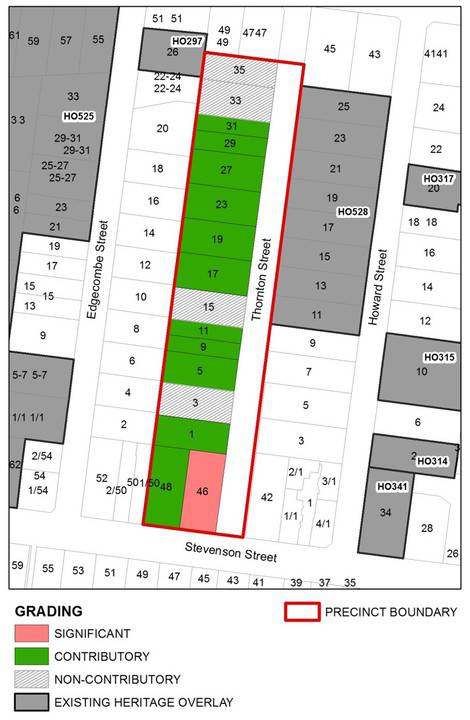
The Thornton Estate Precinct, which comprises 1-35 Thornton Street
and 46-48 Stevenson Street, Kew, is significant. The Thornton Estate
was subdivided in 1918. The houses were largely built between c.1920
and 1930, with the exception of 48 Stevenson Street, which may have
been built c.1935-38. The street plantings of uniformly spaced and pruned mature plane
trees on the west side, and dense mature plantings on the east side.
The lawn nature strip and concrete footpaths in the public domain
contribute to the Precinct's significance. The house, front fence, gateway, and garden paths at 46 Stevenson
Street is individually Significant. Intact original front fences at 19
Thornton Street are contributory. Non-original alterations and additions to the houses in the Precinct
are not significant, including the second storey additions, garages,
high brick front fences. Some of the front fences are sympathetic to
the architectural style of the houses, but are not significant. High brick front fences at 5 Thornton Street and lightweight modern
palisade fences at 1 and 33 Thornton Street are not significant.
How is it significant?
The Thornton Estate is of local historic and architectural
significance to the City of Boroondara.
Why is it significant?
The Thornton Estate Precinct is significant for its ability to
demonstrate the continuing pattern of subdivision of large
Victorian-era estates built along the south side of Studley Park Road,
Kew, during the early interwar years. The Thornton Estate comprised 15
allotments subdivided from the former substantial home named Thornton.
The subdivision remains legible because of the consistent streetscape
character along its extent, created by the uniform and evenly planted
street trees, lawn nature strips and early concrete footpath, and the
consistency in architectural style of the houses (diverse forms of the
interwar California Bungalow), set behind generally medium-height
front fences in garden settings. (Criterion A) Architecturally, the Thornton Estate Precinct is significant for the
consistency of the architectural style of the houses, interwar
California Bungalow. This is because the houses in the Thornton Estate
were largely all built over a five-year time span, from c.1925-30; the
exception may be 48 Stevenson, built c.1935-38. This distinguishes the
Thornton Estate Precinct from other interwar precincts which were
generally built over longer time spans and thus represent a greater
diversity of architectural styles. Even though each house is built to
very distinctive designs, they display features typical of the
California Bungalow idiom, including visually prominent roofs, many
with visually prominent street facing gables, flat top chimneys, some
houses with shingling (19 Thornton and 48 Stevenson streets), heavy
masonry verandah piers and balustrading, and projecting timber window
frames, and geometric pattern leadlight glazing. (Criterion D) Architecturally, 46 Stevenson Street is significant as an interwar
Bungalow that exhibits many features typical of the interwar brick
Bungalow style, a popular idiom for domestic architecture in the
suburbs during the 1920s. Its significance is enhanced by the high
degree of intactness of the house and its grounds (front fence, garden
paths, gateway and gate) and the high quality of the detailing evident
in these original features. The intactness of 46 Stevenson Street, and
the integrity of the site as a whole, compares favourably with some of
the best-known interwar landmark corner houses in Melbourne.
(Criterion D) The architectural significance of the Precinct is enhanced by the
architectural quality and integrity of some of the contributory
places. Some of the houses retain early and original front fences (46
and 48 Stevenson Street and 19 Thornton Street). (Criterion D)
Grading and Recommendations
Recommended for inclusion in the Schedule to the Heritage Overlay of
the Boroondara Planning Scheme as a precinct.
Group
Residential buildings (private)
Category
Residential Precinct