
| Back to search results » | Back to search page » |


|
PAKENHAM STATE BANK & WAR SERVICES HOMES GROUP
Other NameReview, New Location11, 14, 17 & 5/19 ROGERS STREET, PAKENHAM, CARDINIA SHIRE LevelIncluded in Heritage Overlay |
|





Statement of Significance
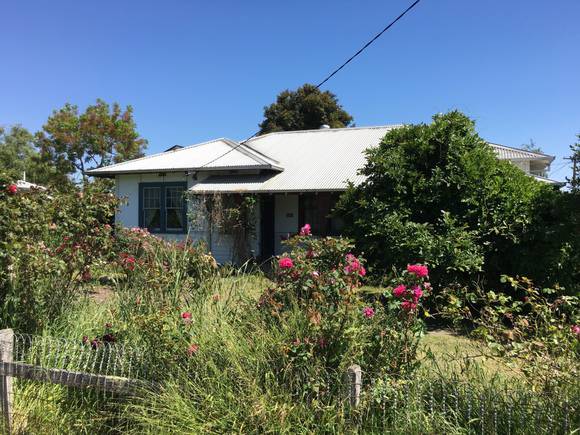
What is significant? The houses are interwar timber bungalows built to standard SSBV
designs (or variations) with similar form, materials and detailing.
All are asymmetrical in plan and have hipped corrugated iron roofs
(with deep eaves and visible rafters) that extend to form verandahs to
one side of the projecting gabled (11, 19) or hipped (14, 17) bay.
Windows are timber framed sash with multi-pane upper sashes, usually
arranged in pairs or triples to the main elevations. Walls are clad in
weatherboards with fibro-cement to the upper walls (11, 17, 19) or
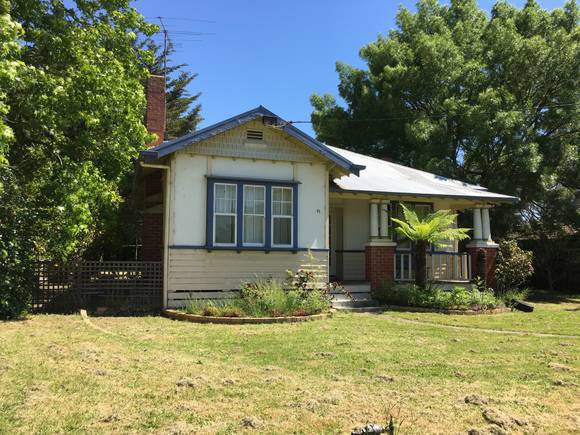
full weatherboard (14). All have at least one plain brick chimney. 11
Rogers Street appears to be a variant of SSBV Type 21 design. Here,
the verandah is supported by paired Tuscan columns set on brick piers,
there are double entry doors and there is timber shingling to the
gable end with a small louvred vent. It has a high degree of external
integrity and intactness. The houses at nos. 14, 17 and 19 are of
interest because they use standard SSBV designs (or variants)
specifically intended for use in country areas. A specific detail that
sets these houses apart is the use of angled timber blade brackets to
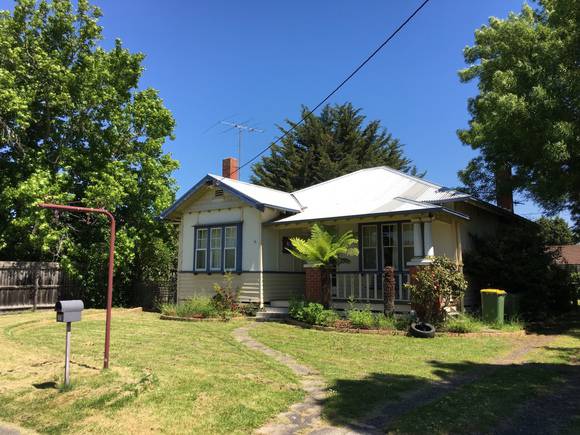
the verandahs. Nos. 14 and 17 use the SSBV Type 32 design. This type
is distinguished by a broad hipped roof that extends to form a return
verandah, while another unique feature is how the entrance is at the
side of the verandah rather than facing toward the street. At no.17
the designhas been varied by extending the house by one room on the
right side and deleting the verandah return. The house is relatively
intact, but the chimneys have been removed. The woven wire fence at
the front appears to be original or early. No.14 has the original Type
32 design, with the addition of a four sided bay window to the
projecting bay. Apart the partial enclosure of the side verandah the
house is relatively intact. 19 Rogers Street is an intact example of
the SSBV Type 33 design. The distinguishing feature here is the
half-timbering to the gable end. Non-original alterations and additions to the houses, the front
fences at nos. 14 & 5/19 and timber side and rear fences on all
sites, and other buildings on the sites are not significant.
How is it significant?
Why is it significant? As a group the houses are distinctive for their similarity of form,
materials and detailing that identify them as Bank Home designs, with
subtle variations in detailing providing individuality and interest.
The relatively high degree of integrity of most of the houses, which
includes an original or early woven wire fence at no.17, contributes
to their significance. (Criterion E)
The Pakenham State Bank and War Services Homes Group, comprising
the houses built by or on behalf of the State Savings Bank of Victoria
or War Service Homes Commission between 1929 and 1931 at 11, 14, 17
& 5/19 Rogers Street, Pakenham is significant.
The Pakenham State Bank & War Services Homes Group is of local
historic and aesthetic significance to Cardinia Shire.
It is significant as an illustration of the beginnings of the
growth of Pakenham beyond the historic Main Street township centre
during the interwar period and also demonstrates the role played by
the State Savings Bank of Victoria and the War Service Homes
Commission in providing affordable housing in Victoria. The houses at
nos. 14, 17 and 19 are of note as examples of the SSBV designs
specifically intended for use in country areas. (Criteria A & D)
Group
Residential buildings (private)
Category
House