
| Back to search results » | Back to search page » |


|
Erinvale
Location285 Gully Road CERES, GREATER GEELONG CITY LevelIncluded in Heritage Overlay |
|






Statement of Significance
What is Significant?
Why is it significant?
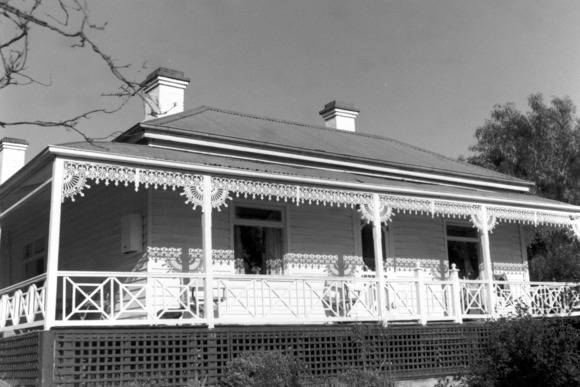
'Erinvale' at 285 Gully Road is aesthetically significance as a
moderately intact and representative example of a late Victorian
style, being one of few timber examples of its type in the Ceres area
(Criterion D), the most comparable nearby being the dwelling at 230
Merrawarp Road, Barrabool (built in c.1896). 'Erinvale' reflects
several late Victorian design qualities on its elevated setting, most
noticeably the hipped roof forms, post-supported return verandah, roof
and wall cladding, brick chimneys and some verandah detailing.
'Erinvale', 285 Gully Road, has significance as a moderately
intact and locally rare surviving example of a late Victorian styled
timber dwelling in Ceres associated with the second generation of
farming in the Barrabool Hills. Built in late 1896 or early 1897 for
William Heard (1863-1914), farmer and son of the local pioneer farmer,
Thomas (1825-1903), the dwelling is a physical legacy of the continued
progress in farming in the district in the late 19th century. The
significant fabric of 'Erinvale' includes: asymmetrical composition,
elevated single storey height, hipped roof forms, hipped, convex,
post-supported return verandah, corrugated galvanised steel roof
cladding, timber weatherboard wall cladding, narrow eaves, brick
chimneys, door front opening, decorative cast iron verandah valances
and brackets and the verandah balustrading. Other external fabric of
'Erinvale' has no significance.
How is it significant?
'Erinvale', 285 Gully Road Ceres, is historically and
aesthetically significant at a LOCAL level.
'Erinvale' at 285 Gully Road has historical significance for its
associations with second generation farming at Ceres in the Barrabool
Hills from the late 19th century (Criterion A). It is one of the few
known surviving examples, having been built for William Heard
(1863-1914), farmer, on land owned by his pioneer farmer father,
Thomas Heard (1825-1903). Thomas Heard had emigrated from England in
1844 with his older brothers, Samuel and John, and sister Elizabeth.
The Heard brothers each took up farming in the Barrabool Shire, the
only other known surviving nearby dwelling associated with the family
being 'Ballanclea', built in 1860 for John Heard. 'Erinvale' is a
physical legacy of farming progress by the second generation of the
Heard family, William Heard, respected farmer, Sunday School teacher
and Vestryman of the neighbouring Holy Trinity Anglican Church. He had
this house built on elevated ground above the Ceres Bridge in late
1896 or early 1897 on his father's land. It remained in Heard family
ownership until 1921-22.
Group
Farming and Grazing
Category
Agriculture