
| Back to search results » | Back to search page » |


|
ROAD OVER RAIL BRIDGE
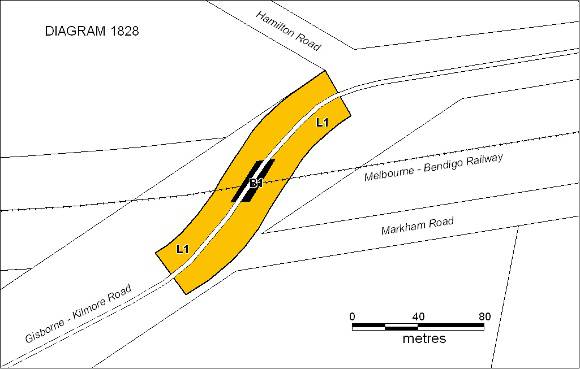
LocationGISBORNE-KILMORE ROAD RIDDELLS CREEK, MACEDON RANGES SHIRE
File NumberHER/2002/000171LevelRegistered |
|




Statement of Significance
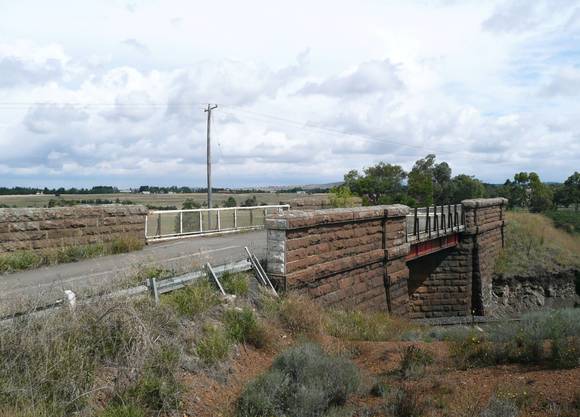
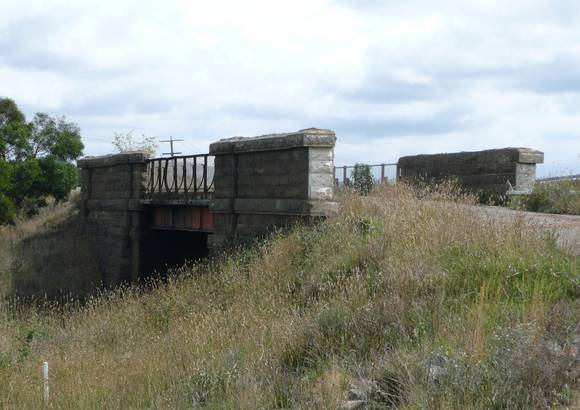
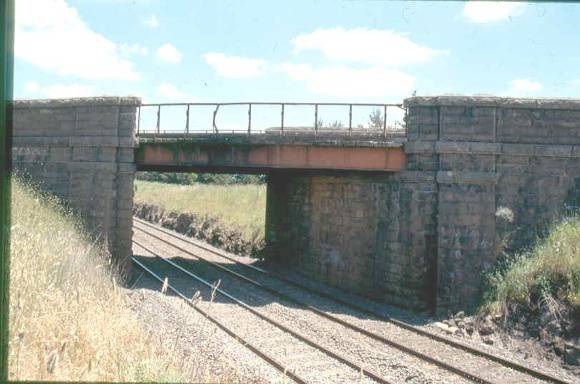
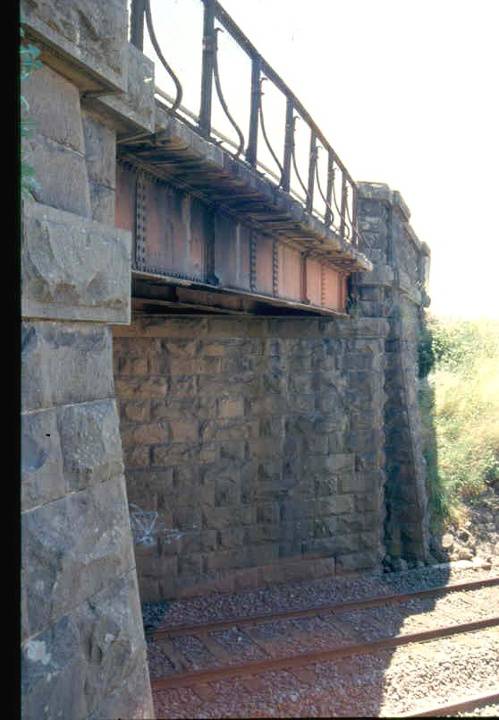
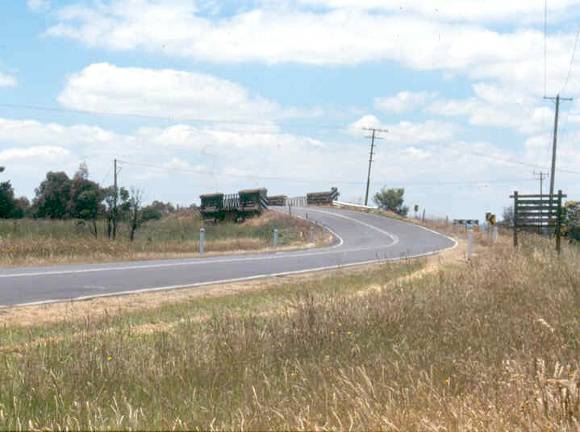
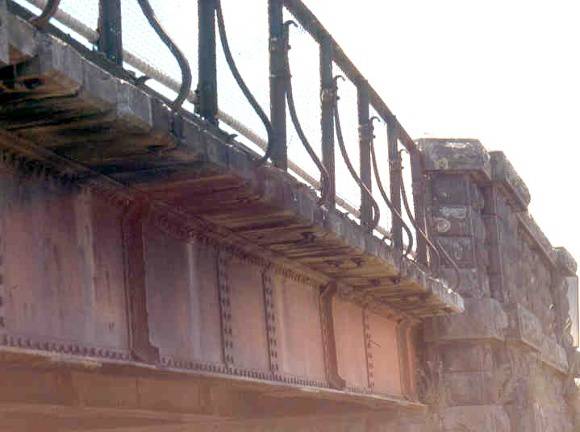
What is significant? The Road over Rail Bridge at Riddells Creek was constructed as part of the Sunbury to Woodend section of the line, which was opened in July 1862. Road crossings of this line were accomplished with masonry arch road bridges where the railway was in a cutting, metal girder road bridges where the railway line was at ground level and masonry arch or girder underpasses where the railway was on a substantial embankment. The railway line here runs at near to ground level and the approaches to the bridge are ramped up in a curve to substantial bluestone abutments. These are built in 360mm deep courses of quarry faced ashlar up to two courses below bearing level, and 300mm above. The abutments are detailed with pilasters on the sides. Two string courses and a substantial projecting capped balustrade provide linear continuity with the base of the girders, the deck level, and the top of the iron handrail. The bridge is skewed to reduce the curve in the road approaches. The bridge structure consists of six riveted plate wrought iron girders with a noticeable camber. Each girder is built up out of wrought iron plates in the web and flanges joined in their length with plate connectors and made into a simple I beam with angle iron. Stiffeners are made up from a rolled T section. The deck is of transverse hardwood. The guardrail spanning between the heavy stone balustrades consists of T section rolled wrought iron uprights with riveted plates at the bottom connecting them to the timber of the kick rail, with a top rail of wrought iron angle. The original bracing, which remains only on the south side, consists of elegantly curved brackets bent from square section wrought iron with bent plate connections to the uprights and to the ends of the cantilevered ends of the deck. The guardrail is now filled with chain mesh attached to a galvanised steel pipe bottom rail - the original infill may have been timber pickets. How is it significant? Why is it significant?
The Road over Rail Bridge at Riddells Creek is part of the Melbourne to Echuca Railway. Opened in five stages from February 1859 to September 1864, this was the larger of the Colony’s first two main trunk lines. The inability of the line’s original private promoters - the Melbourne, Mount Alexander and Murray River Company - to raise sufficient funds to construct the line, led to the government purchasing the company and embracing a public railway system. The Government’s decision to construct the line in 1856 was accompanied by the formation of the Victorian Railways Department. The building of the line during the early 1860s reflected the strategic economic issues of the day: servicing the important goldfields of Castlemaine and Bendigo, and capturing the Murray River and Riverina trade for the Port of Melbourne. With a labour force of more than 6,000 men, the Melbourne to Echuca line was the Colony’s largest capital works project of its time. The line is still used today for public transport and freight services and comprises a very large number of structures and facilities of varying ages, conditions and degrees of operational and business significance.
The Road over Rail Bridge at Riddells Creek is of historical and scientific (technological) significance to the State of Victoria.
The Road over Rail Bridge at Riddells Creek is of historical and scientific (technological) significance as one of the oldest extant metal plate girder road bridges in Victoria in reasonably original form. The association of the bridge with the Melbourne, Mount Alexander and Murray River Railway is significant not only because of the large scale public works associated with the construction of the line and its importance to the economic development of the colony, but also because of the key role that this project played in introducing the use of riveted wrought-iron plate girders within Victoria for both railway and road bridge construction. It demonstrates the high engineering standards and fine workmanship which are characteristic of the Bendigo Railway and provides a marker for the importation and adaptation of British engineering and technology, based on the wealth of gold rushes and increasing political and financial power of the new Victorian Colonial government.
Group
Transport - Rail
Category
Other - Transport - Rail