
| Back to search results » | Back to search page » |


|
WERRIBEE PARK
Other NamesWERRIBEE MANSION , WERRIBEE PARK , WERRIBEE PARK GOLF COURSE , WERRIBEE PARK OPEN RANGE ZOO , WERRIBEE PARK ZOO , WERRIBEE ZOO , ZOO, WERRIBEE PARK Location320 K ROAD WERRIBEE SOUTH, WYNDHAM CITY
File NumberFOL/14/74510LevelRegistered |
|




Statement of Significance
What is significant? Edward Wedge, brother of John Wedge (John Batman's surveyor), was the
first to establish European settlement at Werribee Park (by 1836). In
1852 a devastating flood claimed the life of Edward, and his wife and
daughter. In 1853, the remaining Wedge family members left the Port
Phillip District, and the land was transferred to their neighbour,
Scottish pastoralist Thomas Chirnside. Thomas Chirnside arrived in Australia in 1839 to invest in sheep. By
1875, Thomas and his younger brother Andrew owned 250,000 acres of
freehold land, and large areas of leasehold land, in Victoria. In
addition to running the 93,000 acre Werribee Park sheep station, the
Chirnsides also hosted numerous sporting events, hunts, picnics,
balls, vice-regal visits, and the first Volunteer Military Encampment
in Victoria (1857). The Chirnsides built a complex of bluestone buildings in the 1850s
and 1860s, the oldest being a bluestone four-room ration store, with
each room only accessible externally, and a four- room bluestone
house, known as Bellenger's house. Both are believed to have been
built sometime in the late 1850s or early 1860s, based on the style
and materials available at that time. A large bluestone woolshed
(1861-2) saw 45,000 sheep produce 506 bales of wool in one year.
Originally a one-room building, the simple four-room bluestone
shearers' house, just east of the woolshed, and the basalt and brick
sheep dip, just southeast of the woolshed, are likely to have been
built in the early 1860s. The bluestone Chirnside homestead (1865), with associated ha-ha wall
(1867), was built primarily as a permanent base for Thomas's nephew
Robert, who managed the sheep station from 1859 until 1866 and was
then a lessee until 1873. The garden surrounding the homestead
features an impressive Ficus macrophylla, and framing the central view
are two Lagunaria Patersonia, near the ha-ha wall. The bluestone
stables (built by 1868) housed prize winning stallions and the winners
of the Melbourne, Caulfield and Geelong Cups. The men's quarters
(1880s) is a large rectangular bluestone building with a bell turret.
The large rectangular bluestone blacksmith's shop (post 1880) retains
its original forge. The U-shaped brick implement shed (1890s) reflects
the Chirnsides' move away from pastoral activities to farming. The
burial area, surrounded by a near-square bluestone wall, contains the
graves of Patrick Logan Edgar, who died in 1858, and John L. Hamilton,
who died in 1863. Hastie's house (1890s), named after Adam Hastie who managed Werribee
Park for George Chirnside, is a 10-room double fronted building
located near the shearers' house. It is the last surviving substantial
weatherboard building associated with the Chirnsides on the property,
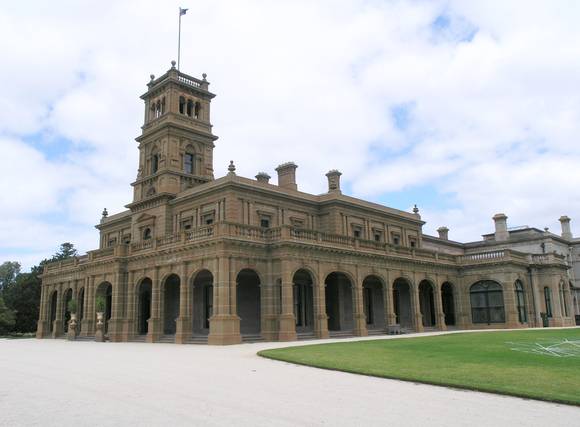
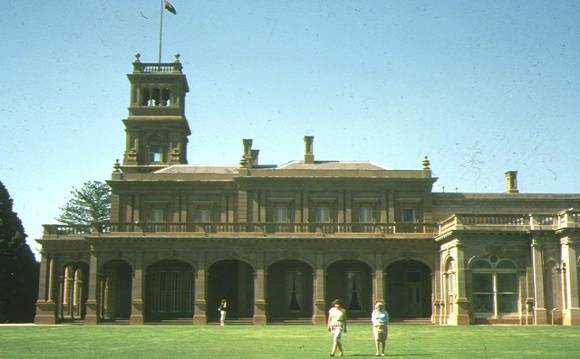
and one of the few known to be occupied by staff. Thomas and his brother Andrew began construction of the mansion in
1873, primarily for Andrew and his family. The large basalt and
sandstone mansion, built in a Renaissance Revival style, is a two
storey central block, with dominant tower and an arcade surrounding
three sides of the block. The fine interior with some original
furniture features a richly decorated entry hall, containing a Minton
encaustic tiled floor, niches, Corinthian pilasters and free standing
columns, leading to a grand staircase and providing access to the main
reception rooms. The library and dining room have heavy pedimented
polished timber architraves, and tongue and groove Kauri pine floors
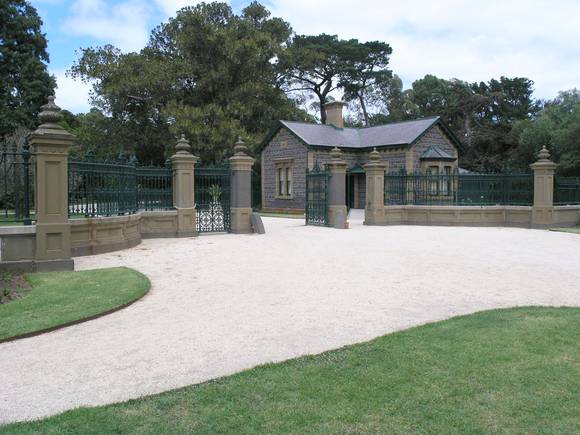
with deep polished parquet borders. A detached bluestone laundry, with its own cistern and drying yard,
was built in the mid 1870s. The gates and gate lodge were built in
1877. It was reported that by completion of works, the mansion cost
over £60,000. The flat open plains contain scattered River Red Gums, Lightwood and
She-oak, windbreaks of Monterey Cypress, Monterey Pine, Aleppo Pine
and Sugar Gum trees and an orchard, enclosed by a post and rail fence
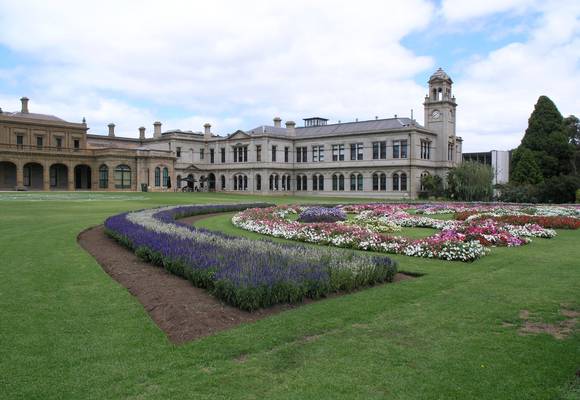
with an English Hawthorn hedge. The Chirnsides' active membership in the Acclimatization Society is
reflected in the mansion's large formal garden (from 1877). Features
within the garden include a man-made lake and grotto (1870s), large
circular parterre (1882) and a rustic fountain, two glasshouses (1880
to 1890s - the sunken glasshouse was replaced by an identical
structure in the 1970s), and an iron hurdle fence and Pittosporum
hedge. The intact rock-work grotto is lined with decorative seashells,
fragments of mirrored glass, pebbles, and sheep bones and teeth. The
outside of the grotto is covered by a large Aloe arborescens. The formal garden's meandering paths, shrubberies and trees were used
to frame views, illustrating the influence of the 18th century English
landscape movement. There is a dominance of conifers and evergreen
trees, especially Araucaria, Pinus, Cupressus, Ficus, Cedrus, Schinus,
Lagunaria, Corymbia and Eucalyptus. Deciduous Ulmus, Quercus
Phytolacca, and the palms, Phoenix canariensis, P. reclinata,
Trachycarpus fortunei have been planted to provide foliage contrast in
the landscape. The Park also contains a significant collection of cypress (Cupressus
now Hesperocyparis), including the State's largest and finest Cupresus
torulosa, rare and outstanding Cupressus macrocarpa 'Filipendula,
'Aurea Saligna, and 'Horizontalia Aurea', large and outstanding Ficus
macrophylla, Lagunaria patersonia, Phytolacca dioica, Elaeodendron
croceum, Quercus bicolor, Ulmus minor 'Variegata', and Corymbia
citriodora. The garden includes Victoria's only known example of
Plagianthis betulinus, and one of 6 plants of Dovyalis caffra. Following the deaths of Thomas, in 1887, and Andrew, in 1890, the
property was passed on to Andrew's sons, George and John Percy. The
dissolution of the Chirnside estate began in 1893, when 8,847 acres
were sold to the Melbourne and Metropolitan Board of Works. A further
23,485 acres was acquired by the Victorian Government in 1906 under
the Closer Settlement Scheme, reducing Werribee Park to 2,270 acres. The scaled down area of Werribee Park remained in the ownership of
the Chirnside family until George Chirnside sold the land to grazier
Phillip Lock in 1921. The following year, Lock sold the property to
the Catholic Bishops of Victoria. The mansion was converted into a
seminary, Corpus Christi College, for the training of priests. Major
additions to the mansion at this time included the St Joseph's wing, a
library and the refectory (1925-28), and the theatre wing (1936-37),
altering the mansion's function from domestic to institutional.
Imitative detail was used externally to unite the early and modern
work. The Catholic Church owned the property until it was acquired by the
Victorian Government in 1973. Approximately 130 acres was reserved for
the Werribee Park Golf Course, which opened in 1976. In 1977, the
Victorian Government opened the mansion and gardens for public
viewing. At that time a substantial part of the original furnishings supplied by Taylor &
Sons, Queen Victoria's Edinburgh cabinetmaker remained in the house,
together with a significant collection of nineteenth century
decorative arts provenanced from elsewhere. The northern section of Werribee Park was handed to the management of
the Zoological Board of Victoria, who opened the Werribee Open Range
Zoo in 1983. A further portion was designated for the development of
the Werribee Park National Equestrian Centre, officially opened in
1984 as the state centre for equestrian activity. The Melbourne
Metropolitan Board of Works assumed management responsibility of the
1870s mansion in 1985. Another six acres of the Werribee Park property
was developed as the Victorian State Rose Garden (1986), which
contains over 5,000 locally and internationally bred roses. It was the
first garden outside of Europe awarded the International Garden of
Excellence by the World Federation of Rose Societies (2003). In 1996, management of the mansion was transferred from the Melbourne
and Metropolitan Board of Works to Parks Victoria. In the late 1990s,
the seminary wings were converted for hotel use and a hotel building
was added between 1998 and 2000. The hotel opened in June 2000. A
vineyard and winery, and polo pavilion were also added at this time. Werribee Park is the traditional land of the Wurundjeri on the east
side of the Werribee River and the Wathaurung Aboriginal Corporation
(trading as Wadawurrung) on the west side of the river.
How is it significant?
Why is it significant? Werribee Park is of historical significance for its association with
the early establishment of permanent European settlement of the Port
Phillip District, dating to 1836 by Edward Wedge. It is significant
for its association with prominent Victorian pastoralists Thomas,
Andrew and Robert Chirnside. In addition to using Werribee Park as a
sheep station, it was also a centre for numerous and lavish social
activities in the 19th and early 20th century. Werribee Park is of historical significance for the mansion's
conversion into the first major Catholic seminary for secular priests
in Victoria, Corpus Christi College. The foundation of the College in
1923 was an important achievement by Daniel Mannix, Catholic
Archbishop of Melbourne, who established the seminary to train
Australian-born students. Werribee Park is of scientific (horticultural) significance for its
rare and outstanding collection of trees, especially conifers
comprising of Pinus Araucaria, Cedrus and cypress (Cupressus now
Hesperocyparis). The garden includes Victoria's only known example of
Plagianthis betulinus, and one of 6 plants of Dovyalis caffra. Werribee Park is of archaeological significance for its demonstrated
and potential archaeological values relating to the Wedge family
occupation, and the occupation and pastoral activities of the
Chirnside family. Archaeological surface deposits have been identified
in the area of the 1865 homestead, ration store, men's quarters,
stables and Bellenger's house, as well as the orchard remnants, ruins
within the orchard, the ford and the burial site. Werribee Park is of aesthetic significance for its extensive size and
collection of planting, landscape styles and features. The formal
garden contains a number of well established specimen trees, rows,
avenues and groups of trees to create a landscape of outstanding
quality and diversity. The garden has contrasting informal and formal
areas with layers of 19th and 20th century planting and development.
The colourful circular parterre is the best example of this design
feature in Victoria. Werribee Park mansion and formal garden are of aesthetic significance
as one of the few places in the State to retain the characteristics of
a 19th century English country house and landscape. The retention of
the original layout, boundaries, early plantings and garden features
are fundamental to the significance of the mansion. The landscape of
the property including its relationship with the Werribee River and
the formal presentation of the Mansion are also significant.
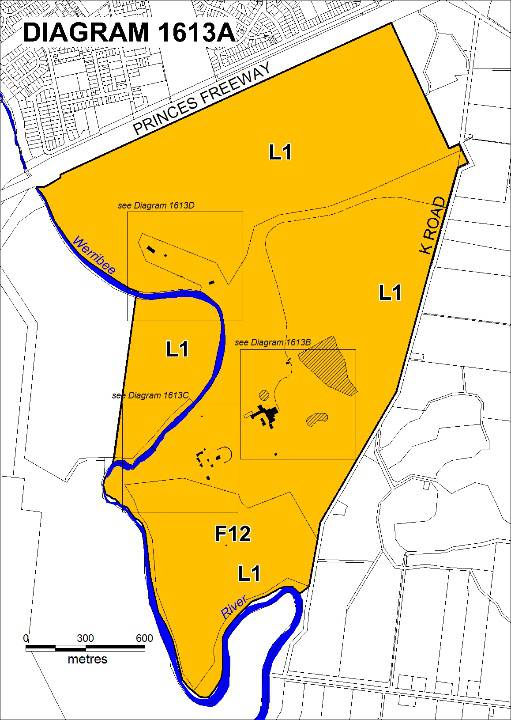
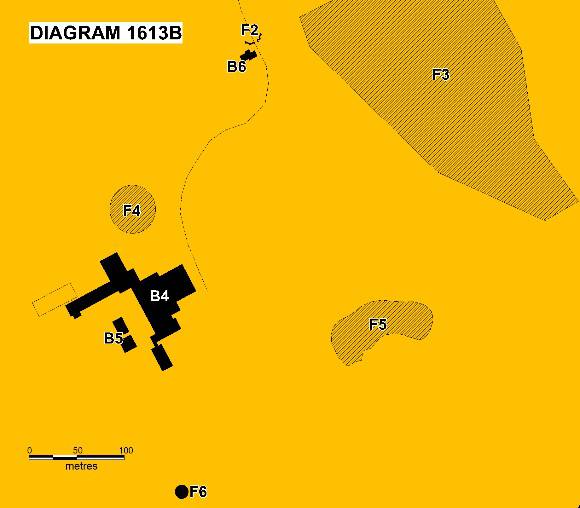
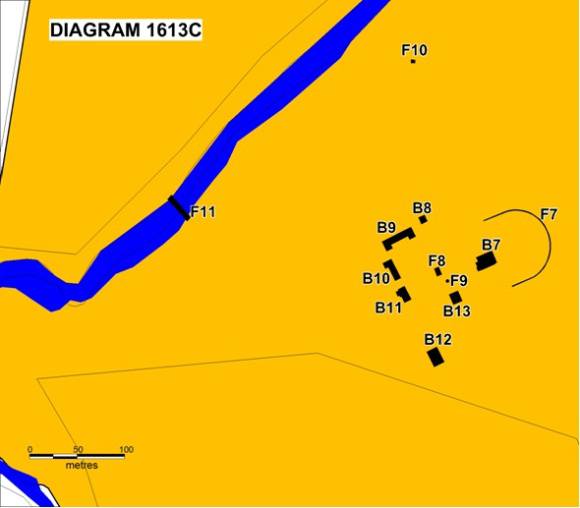
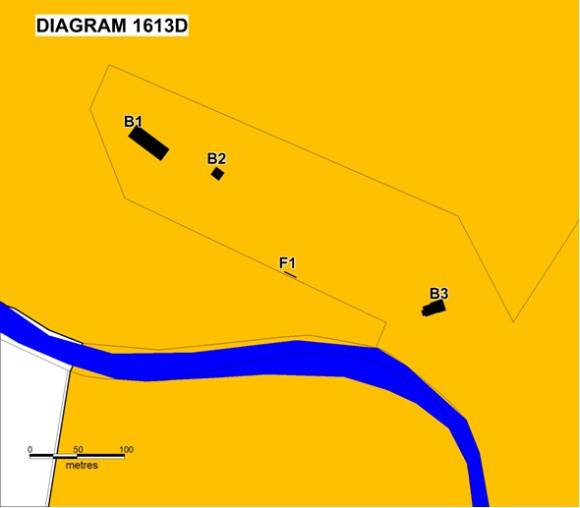
Werribee Park is set on approximately 1,000 acres of land 35
kilometres southwest of Melbourne. The area includes the Werribee
Mansion (1873) with formal garden, grotto, mansion gates and gate
lodge, freestanding laundry, the Chirnside homestead (1865) with ha-ha
wall, ration store (built by 1861), blacksmith shop, men's quarters,
stables, implement shed, Bellenger's house, ford, woolshed, shearers'
house, Hastie's house, sheep dip, and burial site.
Werribee Park is of architectural, historical, scientific
(horticultural), archaeological, and aesthetic significance to the
State of Victoria.
Werribee Park is of architectural significance for the number of
intact buildings and features constructed during the late 19th
century, under the ownership of the Chirnside family. The mansion,
with its fine interiors and some original furniture, is one of
Australia's grandest and most finely designed English country houses.
Since its construction in the 1870s, little has been altered
internally and externally. The mansion demonstrates the finest
application of renaissance detailing in Victoria. It is also the
largest and most intact example of the use of Barrabool Hills
sandstone applied to a domestic building in Victoria. The Chirnside
homestead and associated buildings are one of the most intact groups
of homestead buildings in Victoria. Their relationship is visually
discernable in design and date and historic use. The intact mansion
laundry is architecturally significant as a rare example of a late
19th century freestanding purpose built laundry facility. The
remarkably intact grotto (1870s), a traditional component of 17th
century garden design, is the only known example of its type in
Victoria if not Australia. The sunken glasshouse, although not the
original, is one of only two known in Victoria.
Group
Cemeteries and Burial Sites
Category
Isolated Grave/Burial Site